


On this page
- Table of Contents
- OFAC Reporting Deadlines at a Glance
- Which Dealerships Must Follow OFAC Reporting
- Blocked Property Versus Rejected Transactions
- Applying OFAC Reporting to Vehicle Sales, Refunds and Exports
- How to Run an OFAC Reporting Workflow Step by Step
- Records to Keep for Every OFAC Filing
- Annual Blocked Property Report and the September 30 Deadline
- Confirm Your Dealership's OFAC Procedure Before the Next Deal
A rejected payment can create the same kind of external filing duty as money you freeze and keep. Plenty of dealership desks treat a sanctions hit as a note in the deal jacket, then move on to the next customer. That habit is where OFAC reporting requirements start to bite. Screening tells you there may be a problem. Blocking or turning the deal away is what can force a report outside the store, on a clock measured in business days, with the documents that prove what you did.
The pages that follow walk a sales, finance, and shipping team through that line. You will see which events start a filing, how a held deposit differs from a payment you send back, and how a vehicle that never leaves the lot still needs a value story in the file.
Table of Contents
- OFAC Reporting Deadlines at a Glance
- Which Dealerships Must Follow OFAC Reporting
- Blocked Property Versus Rejected Transactions
- Applying OFAC Reporting to Vehicle Sales, Refunds and Exports
- How to Run an OFAC Reporting Workflow Step by Step
- Records to Keep for Every OFAC Filing
- Annual Blocked Property Report and the September 30 Deadline
- Confirm Your Dealership's OFAC Procedure Before the Next Deal
OFAC Reporting Deadlines at a Glance
A reportable sanctions event is not an internal comment. It starts a filing clock. The Electronic Code of Federal Regulations builds OFAC's core reporting framework around a 10-business-day deadline for a person or business subject to U.S. sanctions jurisdiction.
| Reportable event | Trigger | Deadline | Filing route |
|---|---|---|---|
| Initial blocked property report | Property blocked under an OFAC-administered sanctions program | Within 10 business days of the date the property becomes blocked | OFAC Reporting System (ORS) |
| Rejected transaction report | Prohibited transaction that cannot be processed, with no blocking of funds or property | Within 10 business days of the rejection | OFAC Reporting System (ORS) |
| Unblocking or transfer report | Previously blocked property released or transferred | Generally within 10 business days of the action, unless a license or regulatory exception applies | OFAC Reporting System (ORS) |
| Annual report of blocked property | U.S. persons holding blocked property as of June 30 | By September 30 of the same year | OFAC Reporting System (ORS), form TD F 90-22.50 |
Those first three clocks all run from the event date, not from the day someone notices the file is incomplete. If you block funds on a Tuesday, reject a wire on a Wednesday, or release property on a Thursday, write that calendar date in the deal record the same day. Business days skip weekends and federal holidays, so a Friday event does not give you ten calendar days.
Reports go through the OFAC Reporting System, and they are not a one-line notice. The filing has to carry supporting records such as payment or transfer instructions, checks, invoices, bills of lading, letters of credit, or other relevant records. Two jobs sit side by side. Classify the event as blocked or rejected, then keep the evidence and file on time.
A name that looks familiar on a buyer's check cannot live only in a CRM comment. If the store blocks property, or turns away a payment it cannot legally process, that action may be an external filing measured in business days. The rest of this walkthrough shows how to sort each dealership event and which papers support the report.
Which Dealerships Must Follow OFAC Reporting
Screening and reporting are not the same job. Screening is the control step: you compare a buyer, payer, lender, shipper, or consignee with the current sanctions lists before money moves or a vehicle leaves. A reporting duty starts only when the store blocks property or rejects a transaction it cannot legally complete.
The rules reach U.S. persons and activity inside U.S. jurisdiction. That covers a franchised store, an independent used-car lot, the finance office, the service cashier, and a vendor that moves the store's payments or freight. A title clerk in another state who releases a unit for your store is still part of the same question if the deal is yours.
What usually stays inside the store
Most hits never become a filing.
- False positive cleared: The buyer's name matches a list entry, then a driver's license, date of birth, and address show it is a different person. You document the clearance and finish the sale.
- Pause with no sanctions link: Finance holds a deal for a missing payoff letter. Nobody is a sanctions target, so there is nothing to report.
- Hit resolved before funds move: A wire is queued, screening flags the payer, and you confirm the match is wrong before any dollars are accepted. No property was blocked and no prohibited transfer was carried out.
What usually leaves the building
Two patterns change the file from a note into a report. First, you hold funds because a listed party has an interest in them, such as a deposit you will not apply to a car. Second, you turn away a prohibited payment or a shipment you will not release, even though you never take the money into a blocked account.
Practical rule: Write down who decides the bucket. Sales should not invent the answer at the desk, and a vendor should not decide it in a voided-payment email.
Name that person in the written procedure, usually the compliance owner with a backup. Borderline matches, partial ownership questions, and odd refund paths go to counsel before anyone labels the event.
Blocked Property Versus Rejected Transactions
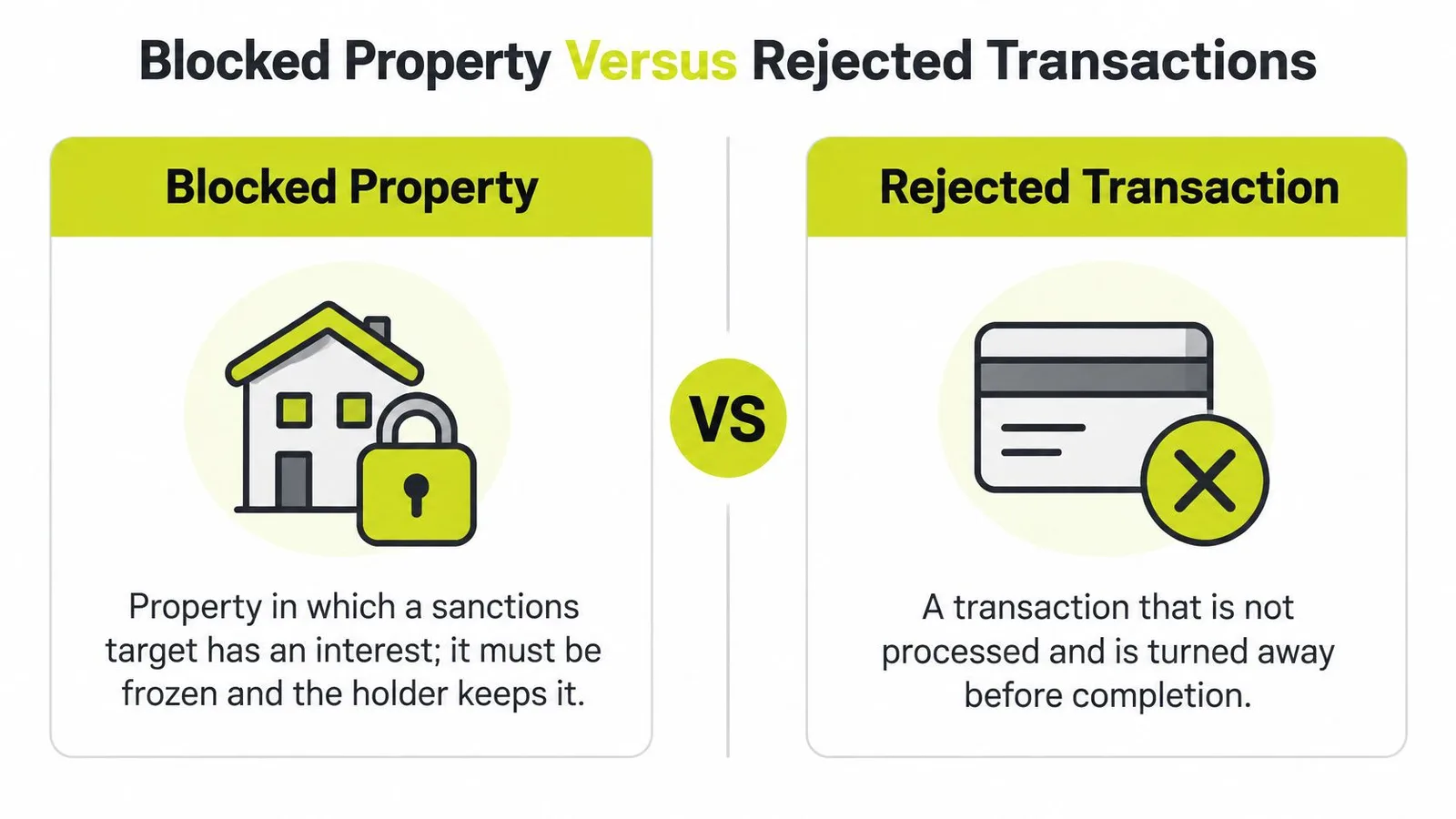
Blocked property is property in which a sanctions target has an interest and which must be frozen. The holder keeps it. You do not apply it to a vehicle, refund it to the listed party, or let it leave in a normal posting. OFAC's introductory guidance puts the initial blocked-property report at 10 business days after the property becomes blocked, filed through the Reporting System, with the screening result, decision rationale, counterparties, identifiers, amount and currency, sanctions program, and payment or transfer papers.
A rejected transaction is different. The deal is prohibited, so you do not process it, but the property itself is not blocked. You decline the wire, the card, or the shipment. That rejection has its own report, also due within 10 business days after you reject it. The classification picks the filing. Mixing the two labels produces the wrong record even when the deadline looks the same.
| Category | Definition | Dealership action | Reporting obligation | Record kept |
|---|---|---|---|---|
| Blocked property | Property in which a sanctions target has an interest and which must be frozen | Holder keeps the property and does not process it | Blocking report within 10 business days of the date blocked | Balance tracked until released and included in the September 30 annual report |
| Rejected transaction | Prohibited transaction that cannot be processed while the property itself is not blocked | Holder declines to carry out the transaction | Rejected-transaction report within 10 business days of rejection | Documented decision rationale and transaction identifiers |
Three hits, three different files
Say the cashier takes a cash deposit and the payer matches a list entry you cannot clear. If that person has an interest in the cash, the store holds the balance, does not apply it to stock, and treats the hold as blocked property. The balance stays on a register until a later release.
Say the bank, or your own office, refuses a wire from a prohibited party and the dollars never sit in your account. That is a rejection. You need the refusal date and a short rationale, not a frozen-funds ledger.
Say an export of a used truck cannot legally leave because of the consignee. You do not ship. The unit stays in inventory as ordinary stock, and the refused shipment is the rejected item. The VIN, booking, and stop order belong in that file.
Make the call on the day of the event. The deadline runs from the blocking date or the rejection date, so a label added a week later rewrites history the filing cannot support.
Applying OFAC Reporting to Vehicle Sales, Refunds and Exports
A cash deposit, a service refund, a parts crate headed overseas: each is an ordinary dealership event, and each can turn into a blocked or rejected filing. The label decides what you report and what value you enter, so classification comes before paperwork.
Property is blocked when a sanctions target has an interest in it and it must be frozen. A transaction is rejected when it is prohibited but the property itself is not blocked. OFAC's FAQ on rejected transactions puts the rejection report at 10 business days and asks for the sanctions target, the rejection date, and the actual or estimated U.S.-dollar value when available.
Use the map below, then stop if a deal does not fit.
| Transaction | Likely classification | Value to report |
|---|---|---|
| Payment from a listed party with funds held | Blocked property | U.S.-dollar value of the funds held |
| Payment from a prohibited party, not held | Rejected transaction | Actual or estimated U.S.-dollar value when available |
| Export or shipment of a vehicle or parts that cannot legally proceed | Rejected trade transaction | Actual or estimated U.S.-dollar value of the shipment when available |
| Refund owed to a listed buyer and held | Blocked property | U.S.-dollar value of the refund held |
| Transaction type unclear after review | Do not classify until counsel decides | Do not enter a value until the classification is confirmed |

Walk the rows in order
A held payment is blocked property. Report the U.S.-dollar amount you hold once you know it. A deposit taken in foreign currency converts for the report only when you have a defensible dollar figure, and the original currency stays in the deal notes.
A payment you refuse is a rejected transaction. Identify the sanctions target, the date you refused it, and the actual or estimated dollar value you have. "Failed screening" fills none of those fields.
A shipment that cannot proceed is a rejected trade transaction, whether the cargo is a car, a powertrain, or a parts order. The value field is where general guides go quiet. A refused shipment still carries a reportable dollar figure, so enter the actual or estimated U.S.-dollar value of the cargo when available and keep the vehicle or parts valuation in the deal file, where the number can be supported rather than guessed. Have counsel confirm the valuation method before the first trade rejection you file.
A refund you owe a listed buyer and then hold follows the held-funds row, at the dollar value of the refund itself rather than the original sale price unless the two match.
Anything that fails the map, including a partial payment, a third-party payer, or a unit already on a truck, stays unclassified until counsel weighs in. Keep this table beside the desk that already watches cash reporting under the Form 8300 guide for car dealers. Cash thresholds and sanctions filings are separate duties, and one deal can trip both.
How to Run an OFAC Reporting Workflow Step by Step
Run the same sequence every time, including Saturday deliveries. Skipping a step is how a clean screen becomes a late report.
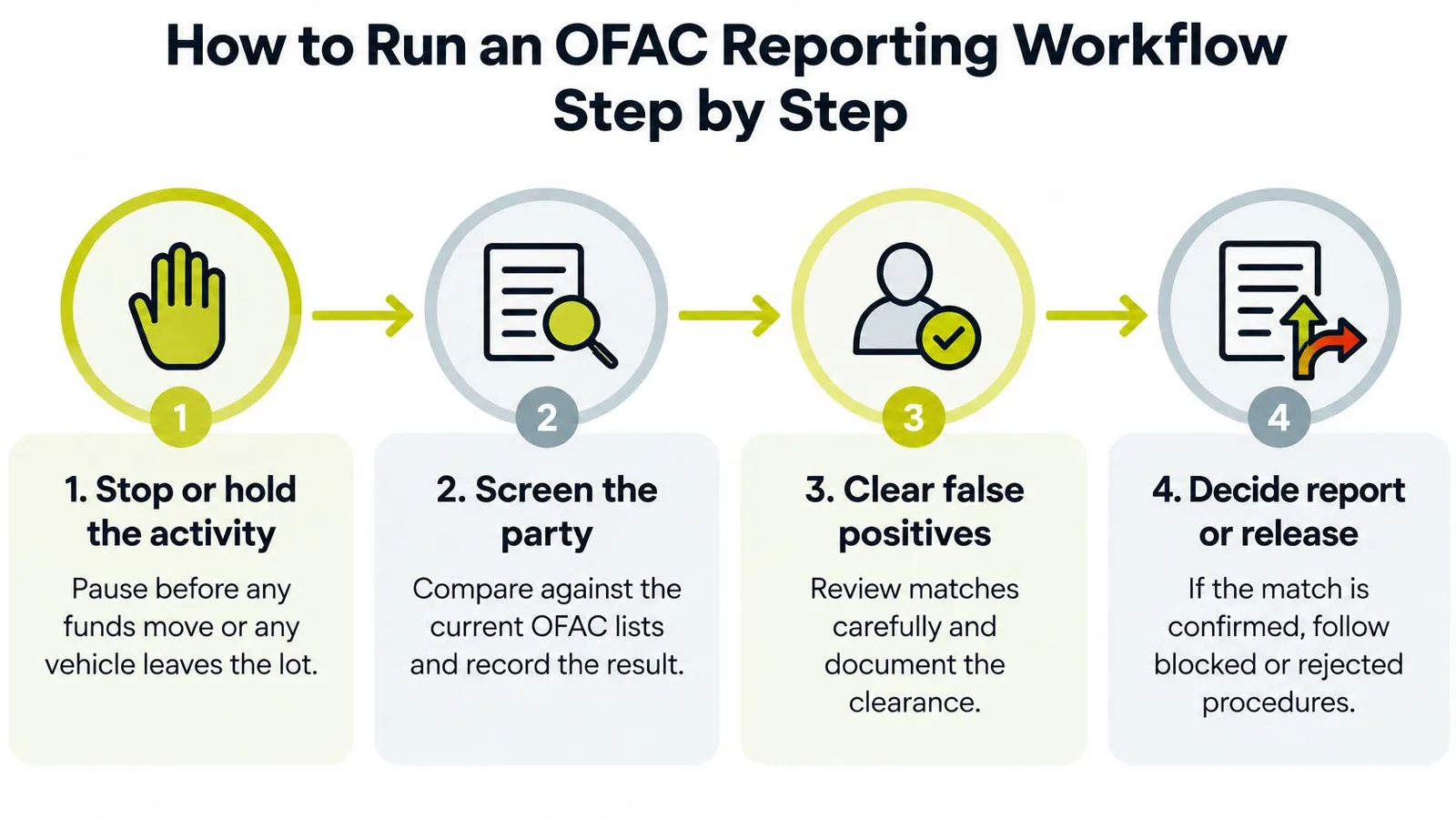
Stop or hold the activity before any funds post and before any vehicle leaves the lot. Tell the cashier, the funding clerk, and the porter the same instruction in writing. The common failure is releasing the car, or applying the deposit, while someone “just checks the name.”
Compare the party with the current OFAC lists and save the screening result, including the list date. Screen the buyer, any payer who is not the buyer, and the consignee on an export. A printout with no date is a weak result. Our OFAC check is one place a store can run that name check and keep the printout with the deal. The common failure is screening only the buyer on the contract and missing the person who wired the money.
Clear false positives with identity documents, or escalate a confirmed or unresolved match to the compliance owner the same day. A similar name plus a different date of birth is a clearance, not a hunch. The common failure is a salesperson marking “looks fine” with no ID copy in the file.
Classify the event as blocked property, a rejected transaction, or no reportable event, and write the reason in one or two sentences. Use the held-versus-turned-away test, not a gut label. The common failure is calling every stop a “block,” which creates a frozen-property record for money you never held.
Record the exact event date and count the filing deadline in business days, not calendar days. Put the due date on the compliance calendar the day you classify. The common failure is counting Saturday and Sunday, then filing late while believing you were early.
Assign one owner for the filing and set a reminder at least two business days before the due date. A backup owner covers vacation and auction weeks. The common failure is a shared inbox with no name, so the deadline passes while three people assume someone else filed.
File through the OFAC Reporting System with the required fields and the supporting documents from the deal jacket. Match the classification you already recorded. Do not rewrite the story to fit a shorter form. The common failure is filing a narrative with no invoice, no wire instruction, and no VIN.
Track any held property until it is released or transferred, and put the later unblocking or transfer report on the calendar when that action happens. A blocked deposit is not finished when the first report goes out. The common failure is applying the old deposit to a new buyer months later with no release record at all.
If step 4 says there is no reportable event, you still keep the screening result and the clearance. You simply do not open an external filing.
Records to Keep for Every OFAC Filing
A correct label with an empty folder is a weak filing. Build one record set for every reportable event, and link it to the deal so an examiner can move from the screen to the report without calling three departments.
| Record | What it shows | Dealership example |
|---|---|---|
| Screening result | Which list matched and the basis of the match | Buyer name hit on a sanctions list during deal review |
| Decision rationale | Why the activity was held, blocked, rejected or cleared | Match cleared as a false positive after a driver's license check |
| Counterparties | Every party to the payment or vehicle transfer | Buyer, lender, payer, shipper and consignee |
| Transaction identifiers | Reference numbers that tie the records together | Deal number, wire reference and VIN |
| Amount and currency | Value in original currency and in U.S. dollars where known | A held deposit recorded as 4,200 in U.S. dollars |
| Sanctions program | The OFAC program that applies to the match | Program named on the matched list entry |
| Supporting documents | Instructions and invoices that evidence the transaction | Payment instructions, invoices, bills of lading or letters of credit |
What each item is doing in the jacket
Work through them in that order, because each one answers a question the next person will ask.
The screening result shows which list matched, the entry, and why you thought it was this person. A buyer-name hit during deal review belongs here, with the date of the search.
The decision rationale is the sentence that says held, blocked, rejected, or cleared. “Cleared as a false positive after a driver's license check” is enough when the ID copy sits behind it. “Manager said OK” is not.
Counterparties means every party on the money or the metal: buyer, lender, payer, shipper, and consignee. A relative who wires the down payment is a party even if the contract shows only the driver.
Transaction identifiers tie the pile together. Deal number, wire reference, and VIN stop a later search from mixing two silver trucks.
Amount and currency records the value in the original currency and in U.S. dollars where you know it. If you only know the contract price and not the refused wire, say so rather than inventing a figure.
The sanctions program is the program named on the matched list entry, not a nickname from a news story.
Supporting documents are the payment instructions, checks, invoices, bills of lading, and letters of credit that show the transaction was real.
Keep the seven items on one deal-level checklist. Retention is not a memory item. Confirm the period with counsel against the current rules in 31 CFR Part 501, write that period into the procedure, and align it with the rest of your dealer record retention practice. Those rules have changed before, and a sticky note on a monitor will not survive the next update.
Annual Blocked Property Report and the September 30 Deadline
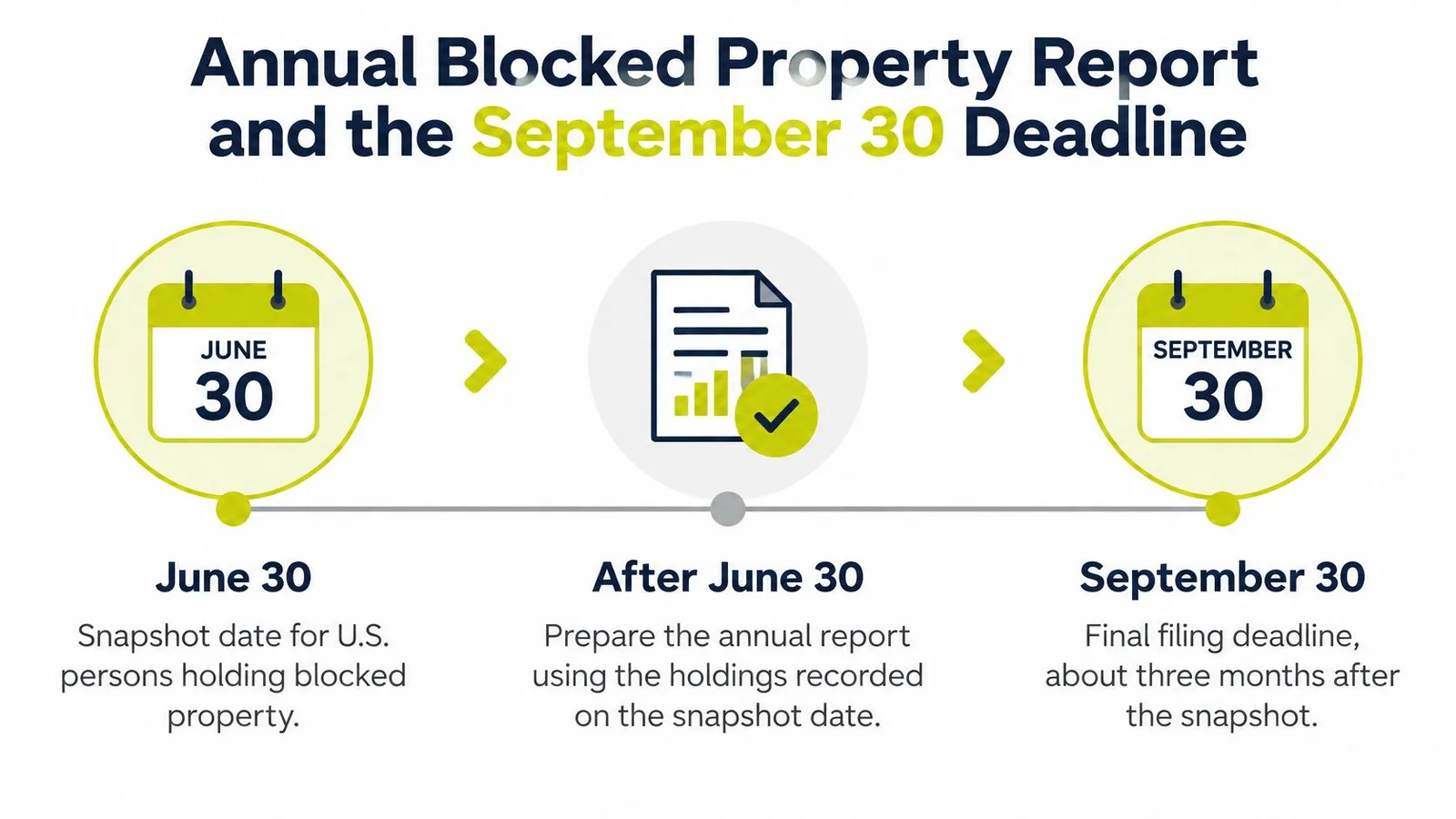
Event reports are not the end of the file if you still hold the property. OFAC's blocked-property FAQ requires U.S. persons holding blocked property as of June 30 to submit an Annual Report of Blocked Property no later than September 30 of that same year. That recurring date sits roughly three months after the snapshot. The filing uses spreadsheet form TD F 90-22.50 and goes through the OFAC Reporting System.
The annual report is still required when the initial blocking report went out on time. It tells OFAC what remains in your possession or control. Property you already unblocked, under a license or because the block ended, is a different story from property still on your books on June 30.
The four points on one calendar
Think of a single held deposit as four dates, not one crisis.
- The day you block the property.
- The initial report, due within 10 business days of that blocking date.
- The June 30 status date, which fixes what you still hold for the annual snapshot.
- The September 30 annual deadline for that same year.
A store sitting on a balance from a blocked payer should diary both the event deadline and the recurring September date. If you unblock in May, the June 30 snapshot should not still list that balance. If you unblock in August, the June 30 figure still included it, and the later release has its own report.
Make the annual filing a copy, not a reconstruction
The annual spreadsheet should match the blocked-property register you kept all year. Each line needs the date blocked, the amount held, and the transaction identifiers already in the deal record. When those three fields are current in July, September is a short exercise. When they are not, someone is rebuilding a year of cashier receipts under a hard date.
A rejected payment you never held does not belong on this annual blocked-property report. The register is for property you still have.
Calendar a mid-July review so the June 30 list is checked while the month is still fresh, then a reminder two business days before September 30. First-time filers should get Reporting System access before that week, not on the afternoon of the deadline.
Confirm Your Dealership's OFAC Procedure Before the Next Deal
Five decisions belong in writing before the next delivery, not during it.
Name the compliance owner who is accountable for every filing, plus one backup. "The office" is not a name. That owner signs off on the classification and on the date each report went out.
Write the screening trigger points for sales, finance, refunds, and exports. At minimum, screen before you accept funds, before you issue a refund to a new payee, and before a unit or a parts order is released to a carrier. A free OFAC search tool can check a buyer against the lists at the desk. CarShots' dealer compliance software runs those OFAC checks together with Form 8300 tracking and staff lessons, so the screen sits inside the deal file rather than becoming a separate habit.
Set the classification rule that separates blocked property, a rejected transaction, and no reportable event. Name the person who decides borderline cases, and write down that it cannot be the salesperson who wants the unit gone today. This is the point where a screening result stops being an internal note and becomes an external filing: blocked property is reported as something you still hold, while a rejection is reported as a transaction you refused, with the rejected trade documents valued at $0.00.
Fix the business-day calendar. Every reportable event gets a due date the same day, with a reminder at least two business days ahead. Count only business days.
Define the retention period with counsel and write it into the procedure. "We keep stuff for a long time" is not a period.
Counsel reviews any confirmed match or any unclear classification before a filing leaves the store. A checklist, a search screen, or a well-meant email does not carry the legal decision. The written procedure does.
A four-question self-check
Pull the last sanctions hit from the deal log, even if you cleared it. Can the team name the owner, the event date, the deadline, and the evidence file? If any answer is a shrug, the procedure is not ready for the next deal. Walk that real example through the stop, screen, classify, and file sequence with the people who touch the money and the keys. Fix the missing name or the missing date before you open on Monday.
If the self-check exposed gaps, CarShots' free compliance questionnaire is a concrete first step. It takes about ten minutes, returns a score, a gap list, and a watermarked draft of your security plan, and needs no card and no demo. Run it this week so the five decisions above are settled before the next deal reaches the desk.
- OFAC reporting requirements
- OFAC compliance dealership
- blocked property report
- rejected transaction report
- OFAC recordkeeping