

On this page
- Table of Contents
- Form 8300 Deadlines and Requirements at a Glance
- Which Payments Count as Cash on a Vehicle Deal
- How to Complete and File Form 8300 Step by Step
- Tracking Installments and Related Payments Over Time
- Customer Statements and Keeping Records After Filing
- Penalties for Late, Missing or Inaccurate Reports
- Test Your Cash Process on the Last Ten Deals
More than $10,000 in reportable cash on a vehicle deal or related transactions generally requires Form 8300 within 15 days after the payment that crosses the threshold. A dealership can also have a reporting obligation when part of that cash arrives as a qualifying cashier's check rather than currency.
That's why a completed form isn't the starting point. Your cashier, sales desk and accounting team need a shared record of who paid, what they used and which deal the payment belongs to. Good Form 8300 instructions should make that record reliable before anyone starts entering information into the report.
Table of Contents
- Form 8300 Deadlines and Requirements at a Glance
- Which Payments Count as Cash on a Vehicle Deal
- How to Complete and File Form 8300 Step by Step
- Tracking Installments and Related Payments Over Time
- Customer Statements and Keeping Records After Filing
- Penalties for Late, Missing or Inaccurate Reports
- Test Your Cash Process on the Last Ten Deals
Form 8300 Deadlines and Requirements at a Glance
The more-than-$10,000 trigger and 15-day filing clock apply to cash received, not merely the amount shown on the vehicle contract, according to the IRS Form 8300 reference guide. The guide also explains that connected payments must be considered together, including payments generally aggregated over a 12-month period.
Use this as your desk-level requirements checklist. Keep the receipt workflow, filing task and follow-up work separate so completing one doesn't hide an unfinished obligation.
| Requirement | Rule | Detail |
|---|---|---|
| Filing trigger | Reportable cash exceeds the reporting threshold in a transaction or related transactions | Review the aggregate, not just the latest receipt |
| Filing deadline | Calculate from the receipt that makes the cash reportable | Apply the weekend and legal-holiday adjustment when applicable |
| Customer statement | Furnish written notice to each person named on the required report | Schedule this separately from filing |
| Electronic filing | Determine whether the business meets the information-return filing rule | Accounting should establish the filing method before a report is needed |
| Record retention | Keep a copy of each filed report | Document the applicable retention period in the dealership's retention schedule |
Receipt date matters. Don't substitute the bank deposit date, delivery date or accounting-posting date for the date staff accepted payment. Those dates may match, but the process shouldn't assume they do.
Assign ownership before taking payment
The cashier should record the receipt, accounting should evaluate the running reportable-cash balance, and a designated filer should own submission and follow-up. Give each responsibility a backup person so an absence doesn't leave the report waiting in someone's inbox.
Keep sanctions screening separate from cash reporting. Your OFAC reporting requirements procedure addresses a different compliance question, even when staff perform both checks during the same sale.
Desk check: If a deal could become reportable through deposits, installments or monetary instruments, open the tracking record before the customer finishes paying.
A spreadsheet can support this workflow. What doesn't work is a note in the sales jacket that says cash deal without identifying the individual receipts behind it.
Which Payments Count as Cash on a Vehicle Deal
Say a buyer brings a $7,000 currency deposit and a $4,000 cashier's check, then finances the balance. Under the payment classification described in the IRS draft Form 8300 instructions, those receipts can total $11,000 in reportable cash, provided the cashier's check qualifies under the applicable rules and no exception applies.
The financed balance doesn't decide the result. Staff must classify the money received rather than label the entire sale cash or financed.
| Payment type | Reportable cash? | How to record it |
|---|---|---|
| U.S. currency | Yes | Add the full amount to the running reportable-cash total |
| Cashier's check or bank draft | Yes, when it qualifies under the IRS definition | Log the face amount, issuing bank and classification decision |
| Traveler's check | Yes, when it qualifies under the IRS definition | Log each instrument separately |
| Money order | Yes, when its face amount and transaction meet the IRS definition | Record the instrument and face value |
| Personal check | No | Keep a copy, but exclude it from the reportable-cash total |
| Wire transfer | Generally no | Save the bank confirmation |
| Card payment | Generally no | Save the processor receipt |
Classify the instrument, not its reputation
A bank-issued instrument isn't automatically outside the cash definition. Equally, staff shouldn't count every cashier's check without examining the instrument and applicable exceptions.
Build a classification field into the receipt log: currency, qualifying monetary instrument or excluded payment. For a monetary instrument, capture the issuing institution and retain the documentation supporting the classification. Escalate uncertain instruments to the compliance owner rather than letting the salesperson choose the answer.
A mostly cashless dealership can still receive reportable payments through a deposit followed by qualifying instruments. Keeping personal checks and card receipts in the deal file remains useful, but adding them indiscriminately to the reportable-cash column creates a different error.
Payment rule: Classify every receipt when staff accept it. Don't leave instrument identification for month-end reconciliation.
How to Complete and File Form 8300 Step by Step
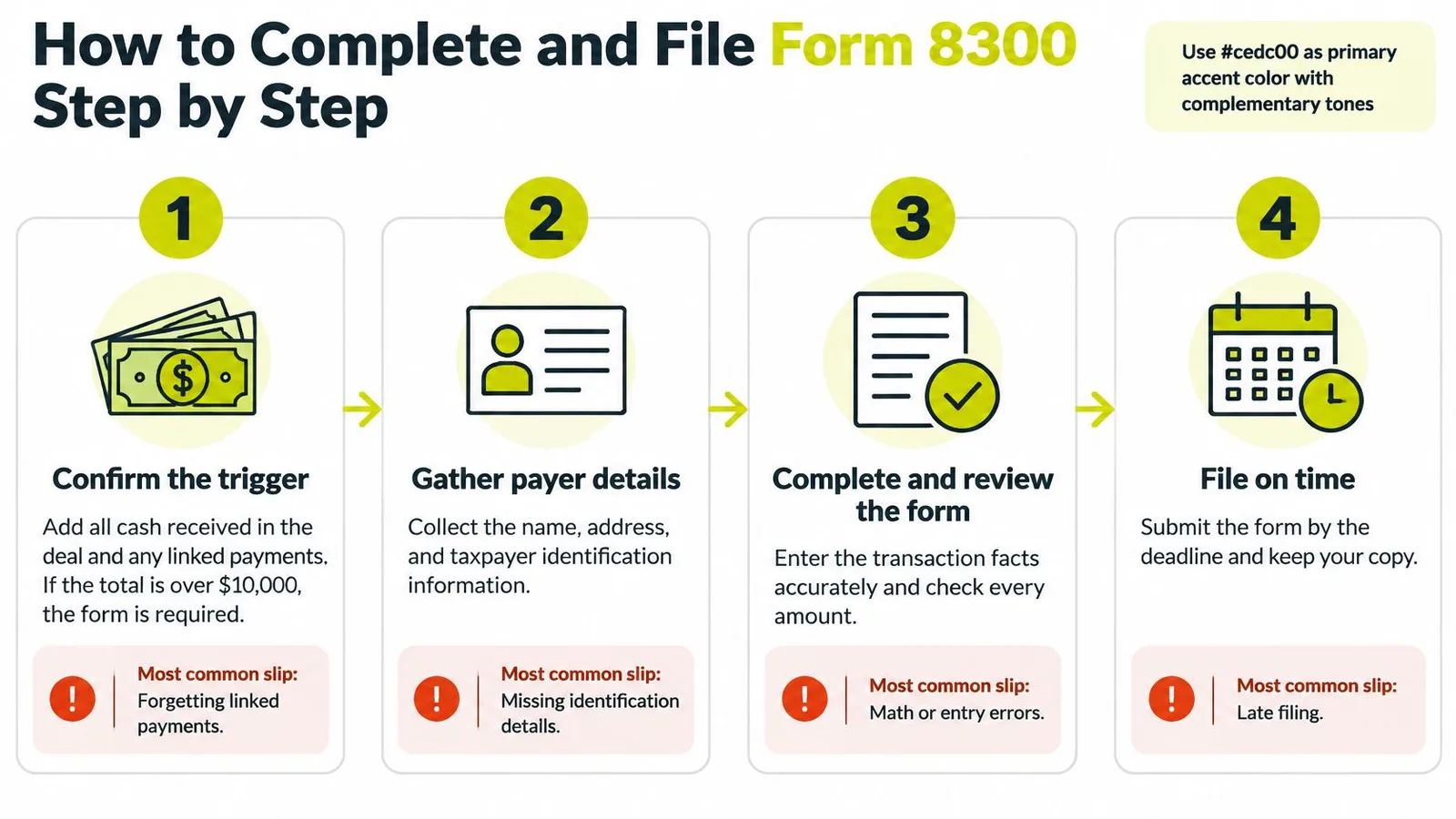
Prepare the report from the receipt ledger and identification records, not from memory or a salesperson's summary. Keep the current form instructions open while completing it, and distinguish the individual delivering payment from any person or business represented.
The process should follow the same sequence each time.
Prepare the report from the deal records
Confirm the reporting event. Reconcile the reportable-cash ledger with the deposit receipts and any linked payments. Don't review only the down-payment line on the buyer's order, because later receipts may change the filing decision.
Identify the payer and represented party. Gather the payer's legal name, address, date of birth, taxpayer identification information and identifying-document details as applicable to the form. If an agent pays for someone else, preserve that relationship instead of replacing the payer's identity with the buyer's name.
Tie the transaction to the vehicle. Use the vehicle identification number, stock number, sale date and transaction documents to support an accurate description. Keep internal stock references consistent across the cashier's receipt, ledger and deal jacket, even where a reference serves as supporting documentation rather than a dedicated form field.
Separate the payment types. Enter currency and qualifying monetary instruments in the appropriate places, then reconcile the amounts to the underlying receipts. A total copied from the contract can be wrong if it includes financing proceeds or excluded payment methods.
Review and submit
Verify the triggering receipt date. Match the report's receipt information to the payment history that created the reporting obligation. Don't assume the contract-signing date is the relevant date, particularly when the buyer paid a deposit before signing.
Complete the filer information and submit. Check the dealership's legal information, contact details and required certification, then use the filing method established for the business. Save the submission acknowledgment or other filing evidence alongside the completed report, and record who submitted it.
A missing taxpayer identification number needs attention while staff can still contact the payer. Document collection attempts and escalate an unresolved gap promptly rather than letting it sit unnoticed until submission.
Before filing, have another employee compare the report against the source documents. Ask that reviewer to check identities, payment classification, arithmetic and receipt dates, not merely whether every box contains something.
The report and deal file should tell the same story. Where the payer and buyer differ, the records should explain why rather than force an artificial match.
Tracking Installments and Related Payments Over Time
A buyer's later installment belongs in the same tracking history as the original deposit. Start by identifying the person handing over the payment and whether that person acts for the buyer, then attach the receipt to the underlying transaction.
The IRS guidance on reporting cash payments requires aggregation of transactions with the same buyer or agent within 24 hours, and beyond that period when the business knows or has reason to know they're connected; filing is generally due within 15 days after the receipt that takes reportable cash above $10,000. Later connected payments can require another report when additional reportable cash exceeds another $10,000.
Follow the receipt sequence
Consider a hypothetical deposit followed by an installment for the same vehicle. The first receipt may not require filing, but the later receipt can create the obligation immediately, without waiting for final payment or vehicle delivery.
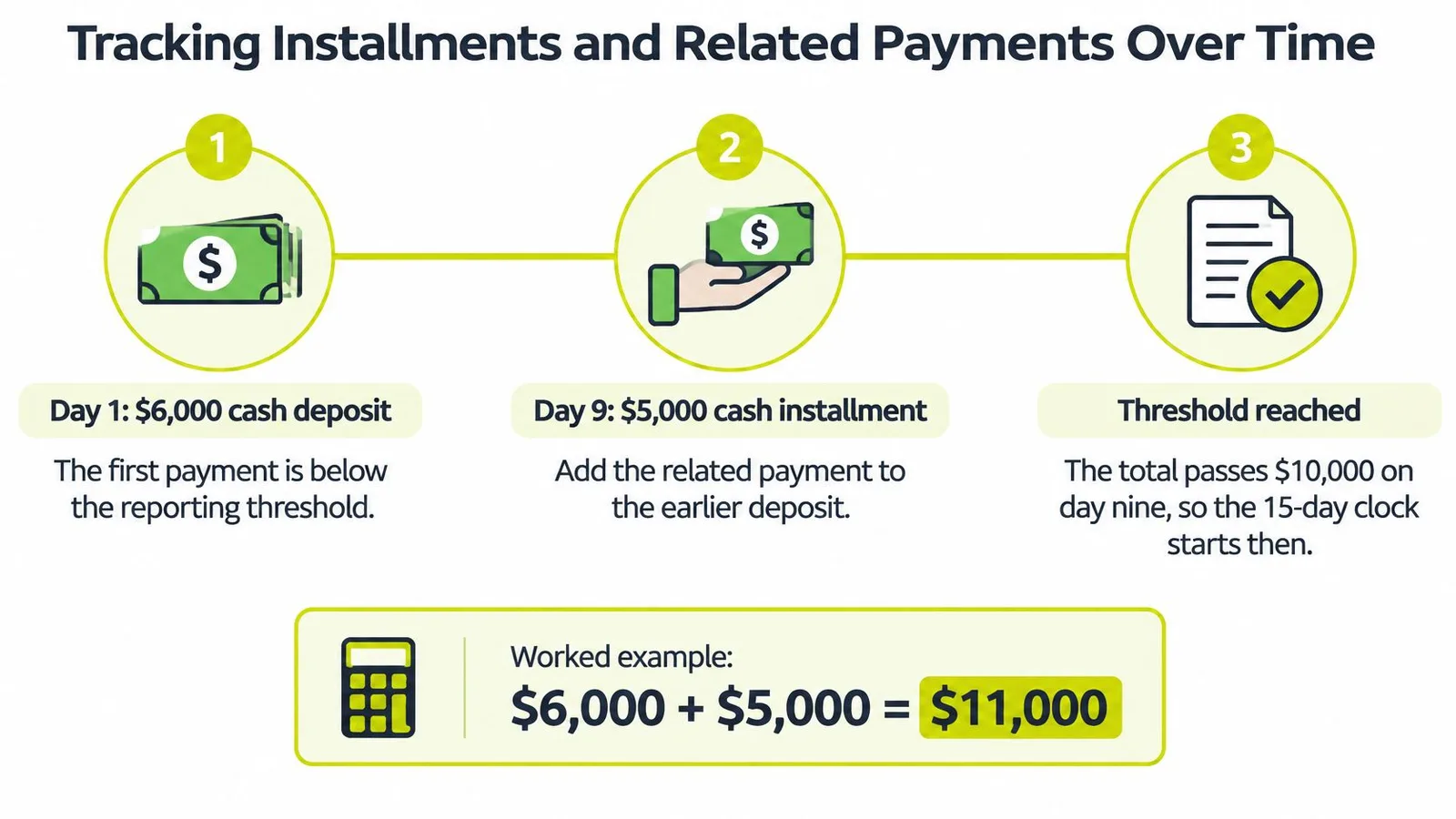
The practical distinction is between a continuing transaction history and unrelated receipt entries. A different cashier, another invoice or a later payment date doesn't establish that payments are independent.
Record these fields at every receipt:
- People: Payer, buyer and any agent relationship.
- Instrument: Payment type and supporting instrument details.
- Timing: Receipt date and timestamp.
- Deal reference: Transaction identifier or stock number.
- Balance: Cumulative reportable cash and the reporting decision.
For a later repair or add-on, document why staff considered it connected or independent. Don't automatically combine every purchase by a repeat customer, but don't treat a new invoice as proof of independence either.
The two avoidable errors are separating connected installments because they arrive on different days and calculating the filing deadline from the initial deposit rather than the triggering receipt.
Customer Statements and Keeping Records After Filing
Filing doesn't finish the job. The IRS cash-payment reporting publication requires a written statement to each person named on a required report by January 31 of the following year; it also explains that businesses required to file at least 10 information returns of other types during a calendar year must electronically file Form 8300, effective January 1, 2024.
Keep the post-filing work visible in the same deal record.

Build the statement and evidence folder
Prepare the statement with the business's name and address, a contact person and telephone number, the aggregate reportable cash received, and confirmation that the information was reported to the IRS. Don't repeat full taxpayer identification numbers because they appear in the filing.
Use a delivery method appropriate for sensitive customer communications, and retain evidence of furnishing the statement. Ordinary unprotected email shouldn't be the default route for documents containing sensitive identifiers.
Maintain a restricted-access folder containing:
- Filed report: The submitted version and acknowledgment.
- Receipt history: Payment amounts, dates and instrument classifications.
- Customer notice: The statement and delivery evidence.
- Decision notes: The basis for linking payments and resolving exceptions.
Align the folder with your dealer record-retention procedure, including a documented retention schedule and controlled disposal process. Don't assume the retention settings for other credit notices automatically suit cash-reporting records.
Use the video as a staff-review aid alongside the written procedure.
Penalties for Late, Missing or Inaccurate Reports
A timely report can still leave the dealership exposed if it's inaccurate or the required customer statement is missing. Submission evidence proves staff sent something, not that every obligation was met correctly.
The IRS Form 8300 instructions describe civil penalties for failing to file a correct report on time or furnish the required customer statement, with higher penalties where the failure involves intentional or willful disregard. They also describe criminal exposure for willful failure to file, false or fraudulent reporting, and assistance with structuring a transaction.
Penalty amounts change over time. Check the current instructions before putting figures into staff training, because a copied penalty schedule ages quickly and can misstate the dealership's actual exposure.
Distinguish mistakes from deliberate avoidance
- Civil compliance failures: Missing information, inaccurate reporting and omitted customer statements need correction even without an apparent attempt to evade reporting.
- Intentional disregard: Treat a conscious decision to ignore the obligation as a serious escalation, not an ordinary paperwork fix.
- Potential criminal conduct: Never help a customer arrange payments to make a required filing appear unnecessary.
A customer's request to split payments deserves review, but installments alone don't establish evasion. The concern is arranging them for the purpose of avoiding reporting.
Never suggest a payment arrangement designed to keep the dealership from filing a required report.
Resolve questions about a proposed arrangement before accepting payment. If staff discover a missed or false report, preserve the records and obtain qualified tax or legal guidance promptly.
Test Your Cash Process on the Last Ten Deals
Assign a named owner to review the last ten cash deals this week. Use the receipts, not just the sales summaries, and make the reviewer reconstruct how each reporting decision was reached.
A familiar spreadsheet is sufficient for this test. Our free Form 8300 worksheet adds up cash and shows whether a dealer must file, but the supporting payment records still need to be complete.
Check the evidence, not the checkbox
For each deal, ask the reviewer to verify:
- Payment classification: Can another employee tell why each receipt was included or excluded?
- Linked receipts: Did staff connect deposits, installments and agent payments correctly?
- Filing evidence: Does the file show the triggering receipt, calculated deadline and submission?
- Follow-up status: Is the customer statement furnished or properly scheduled?
- Record access: Can the responsible employee retrieve the evidence without searching private inboxes?
Add these checks to your deal-jacket checklist so the review becomes repeatable. If a gap concerns a possible missed filing, escalate it rather than merely improving the spreadsheet.
Your action this week is specific: review the last ten cash deals and correct every gap in the tracking log before staff repeat it on another sale.
Our dealer compliance software combines Form 8300 tracking, OFAC checks and staff lessons so cash-reporting responsibilities can sit within a defined dealership workflow. Visit CarShots to explore the free Form 8300 worksheet and the compliance tools that support ongoing deal-level tracking.
- form 8300 instructions
- Form 8300 dealers
- cash reporting dealership
- IRS Form 8300
- dealership compliance