

On this page
A car sits at the curb with a paper sign in the window, and the seller is telling you about the service records. You lean over the windshield, phone in hand, and copy the VIN onto the back of an envelope. Seventeen characters, a few smudged, one that could be an 8 or a B.
What you write down in that moment decides everything that follows. A VIN is a regulated identifier, and reading it is a skill with a short list of failure points. Transcribe it correctly and a free decoder will hand back the model year, engine, body style and assembly plant the factory assigned. Transcribe it wrong and you'll spend the afternoon researching a different car.
This guide treats the VIN for what it is, an identity and specification check. It confirms that the vehicle in front of you is the vehicle on the paperwork. It does not certify condition, and it isn't a history report, two distinctions that matter more than any single character.
Table of Contents
- How to Find and Transcribe Your VIN
- The 17 Positions of a VIN at a Glance
- How to Check the Model Year and Check Digit
- What a VIN Decoder Can and Can't Tell You
- Privacy Rules for Sharing a VIN
- Confirm the VIN Before You Buy or Sell
How to Find and Transcribe Your VIN
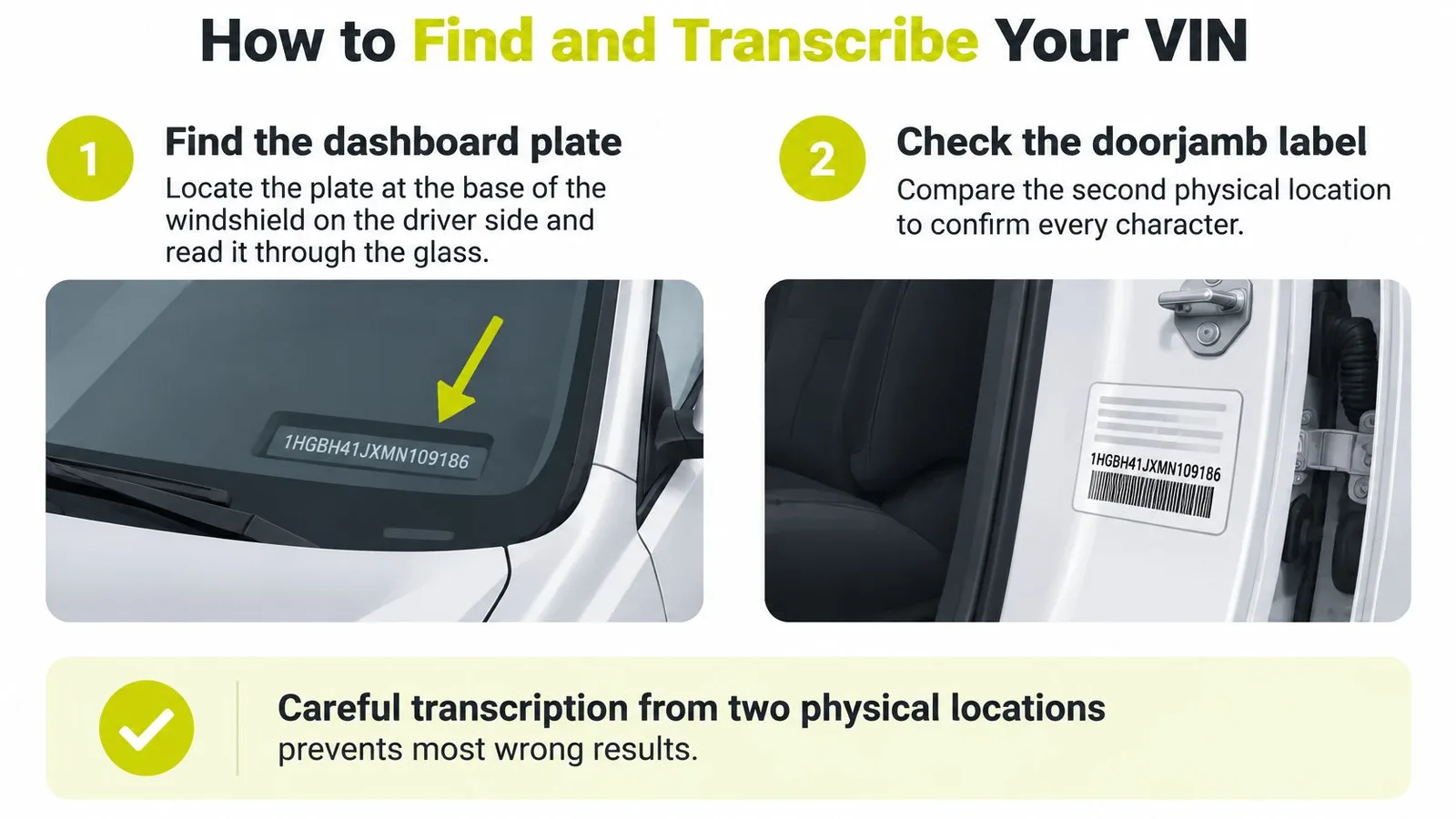
Most decoding errors don't happen inside the decoder. They happen on the envelope, in the driveway, when someone copies a character off a dusty plate and stops there. A dependable workflow reads the whole identifier from at least two physical locations, usually the dashboard plate and the driver-side door-jamb label, and confirms the character count before anything reaches a lookup, which is the sequence NHTSA's VIN transcription guidance describes.
Here's that two-location check in visual form.
Seven steps that prevent a wrong result
1. Read the windshield plate first. Stand at the driver-side front corner and look through the glass at the base of the windshield, where the plate sits on top of the dash. This is the VIN the outside world sees, so it's the one a lender, insurer or officer will compare against your paperwork.
2. Open the driver door for the certification label. The sticker or metal plate on the frame carries the same characters plus build date and weight ratings. Two independent readings from two different labels catch the smudge that one reading alone would hide.
3. Pull a third copy from the paperwork. Your title, registration or insurance card lists the VIN too. The document adds something the labels can't, a link to a named owner and, on a title, a brand history.
4. Write all 17 characters out in full. Copy them onto paper or into a note, one at a time, rather than holding them in your head. Memory is where transposition happens, and swapping two adjacent characters produces a string that looks valid and returns nothing.
5. Count them. Most U.S. and Canadian vehicles from model year 1981 onward carry exactly 17 characters. A count of 16 or 18 means you dropped or doubled one, not that you found a rare vehicle.
6. Question every letter I, O and Q. Those three letters are excluded from the standardized character set because they read as 1 and 0. When your note shows an O, it's almost always a zero, and an I is a one. Q doesn't appear at all.
7. Compare the two readings character by character. Lay them side by side and work left to right. If they differ, go back to the car rather than guessing which version is right.
Worn labels cause most of the trouble. On a door jamb that's seen a decade of sun, an 8 and a B can look alike, and so can a 5 and an S. On a dusty windshield plate, a 6 can pass for a G. Wipe the plate with your thumb, tilt a phone light across it at an angle to catch the stamping, and re-read only the doubtful characters.
A clean transcription looks like this: two identical 17-character strings, no I, O or Q anywhere in them, and a third copy on the registration that matches both.
The 17 Positions of a VIN at a Glance
A VIN works like a form with 17 labeled boxes. Each box holds a single character, and the label under the box matters more than the character sitting in it. NHTSA's decoding materials divide the string along exactly those lines: position 9 is the check digit calculated under 49 CFR Part 565, position 10 carries the model year, and the first eight positions plus position 11 build the vehicle descriptor and plant information (NHTSA vehicle decoding publication).
The string falls into six blocks, and each block answers a different question about the vehicle.
| Positions | Segment | What it tells you | How to use it |
|---|---|---|---|
| 1-3 | World Manufacturer Identifier | Country and maker of the vehicle | Confirms the brand before you trust the rest |
| 4-8 | Vehicle descriptor | Model line, body style, engine and restraint system | Compare against the car you are looking at |
| 9 | Check digit | Confirms the VIN was typed correctly | Pass or fail; it is not a vehicle fact |
| 10 | Model year | Year assigned by the manufacturer | Match to the year in the model year table |
| 11 | Assembly plant | Plant where the vehicle was built | Useful for confirming trim and parts records |
| 12-17 | Production sequence | Serial number from that plant | Meaningless alone; used by manufacturers and recall records |
Read the blocks as questions, left to right. Positions 1-3 answer "who made it," positions 4-8 answer "what did they build," and positions 9-11 answer "does this string check out, and where was it assembled." The last six digits answer only "which unit." Taken together, the VIN works as an identity and specification check: it confirms the car in front of you is the car the paperwork describes. How that car was treated over its life sits in other records, and the VIN merely points you toward them.
Two structural details trip people up. Low-volume manufacturers use a slightly different split toward the tail of the VIN, so a small-batch sports car or imported specialty vehicle may follow a different template than the one above. The other detail is scope: NHTSA's vPIC decoder is built for model years 1981 and later, because earlier vehicles never had a standardized number to decode.
Internationally, ISO 3779:2009 sets the content and structure for road vehicles generally, including trailers, motorcycles and mopeds, so the framework reaches well beyond U.S. dealership lots. Learning to read a VIN number properly means knowing which slots answer which question and which ones you have to look up.
Write the VIN into a six-box grid on paper, one box per segment. Tick each box as you read it and you'll see immediately which parts a decoder returns and which parts you must read off the car yourself. The last box, positions 12-17, has no decoded meaning on its own; it only becomes useful when it's matched against factory build and recall records.
How to Check the Model Year and Check Digit
Position 10 is the fastest single check you can run on a used car, so start there. Find the character in slot 10, then read across this table.
| Model year | Code in position 10 |
|---|---|
| 2010 | A |
| 2011 | B |
| 2012 | C |
| 2013 | D |
| 2014 | E |
| 2015 | F |
| 2016 | G |
| 2017 | H |
| 2018 | J |
| 2019 | K |
| 2020 | L |
| 2021 | M |
| 2022 | N |
| 2023 | P |
| 2024 | R |
| 2025 | S |
| 2026 | T |
So S is 2025, L is 2020, T is 2026. If the listing says 2022 and slot 10 holds an L, the listing is off by two years. A gap like that is usually sloppy advertising and occasionally something worse, so treat it as a prompt to look closer rather than a final verdict.
Why the same letter comes back every 30 years
The code repeats on a 30-year loop. 1981 shares B with 2011, and 1996 shares T with 2026, so a single character never identifies a year on its own. What it does is narrow the answer to a pair of candidates three decades apart.
The car itself settles which one fits. Use the body style in positions 4-8 and the plant code in position 11 to work out which year of the pair matches the vehicle in front of you. A letter shared by 1996 and 2026 is easy to resolve, because the body style, engine family and equipment described in positions 4-8 belong to one era, not both.
If the vehicle predates the standardized 17-character format entirely, the table cannot help. Read the door label and the title directly instead of trusting a lookup.
What the check digit actually proves
Position 9 is arithmetic rather than information. Each character is converted to a numeric value, multiplied by a weight assigned to that position, and the products are summed and divided by 11. The remainder becomes position 9, and a remainder of 10 is written as X.
It works like the last digit of a credit card number: the formula only confirms that the digits belong together.
You won't calculate that by hand, and you don't need to. A decoder or dealer system runs it for you, and a failure is a useful operational flag. Re-transcribe the VIN before any lookup, because one wrong character can return a different vehicle or no result at all. Check the characters most often confused in handwriting and small stamped type, such as 0 and O or 1 and I.
A passing check digit proves only that the string was typed consistently. It does not prove the VIN is genuine, and it cannot catch cloning. Confirming that takes a physical comparison of the plate on the dash, the title and the registration.
What a VIN Decoder Can and Can't Tell You
The most common mistake isn't a bad decoder. It's expecting a decoder to answer a question it was never built for. A 17-character VIN identifies how a vehicle was built, covering manufacturer, vehicle attributes, model year, assembly plant and serial sequence. It does not independently prove accident history, ownership, maintenance, flood damage, title branding or mileage accuracy, as the NMVTIS consumer guidance sets out.
People routinely treat a decoder result as a full vehicle history report. That's where the false sense of certainty creeps in. The decoded output is one layer, and each additional question needs its own source.
| What you want to know | Source to check | What it covers |
|---|---|---|
| Make, model, body, engine and plant | NHTSA VIN decoder | Built-in specifications decoded from the VIN itself |
| Unrepaired safety recalls | NHTSA recall lookup | Open recall status for the vehicle |
| Title brands, theft and latest odometer | NMVTIS report | Current and prior state title data, depends on state and participant reporting |
| Accident history, flood damage and repairs | Vehicle history report and physical inspection | Not in the VIN; a clean result is not proof of no damage |
Every one of those databases is assembled from reporting by states, insurers, manufacturers and other participants. A gap in the reporting shows up as a clean record, not a warning. Treat "no records found" as unknown rather than good.
The check to run before any of them is a physical one. Compare the decoded engine, trim, body style and plant against the car you're standing next to and against the paperwork. A transcription error, a VIN swap or a copied listing makes every later lookup look perfectly valid while describing a different vehicle.
When you need the factory options list rather than the short decoder summary, a window sticker lookup returns packages, original MSRP and equipment that a basic decode leaves out. That's the layer where a specification check starts to overlap with a shopping decision: two cars with the same model year and engine can be thousands of dollars apart once you see what each one left the factory with.
Privacy Rules for Sharing a VIN
A seller photographs the windshield, then posts the full VIN in a marketplace listing right beside a phone number and a neighbourhood. It feels harmless because the same VIN is visible to anyone walking past the car. The assumption worth questioning is that a VIN is always harmless public data.
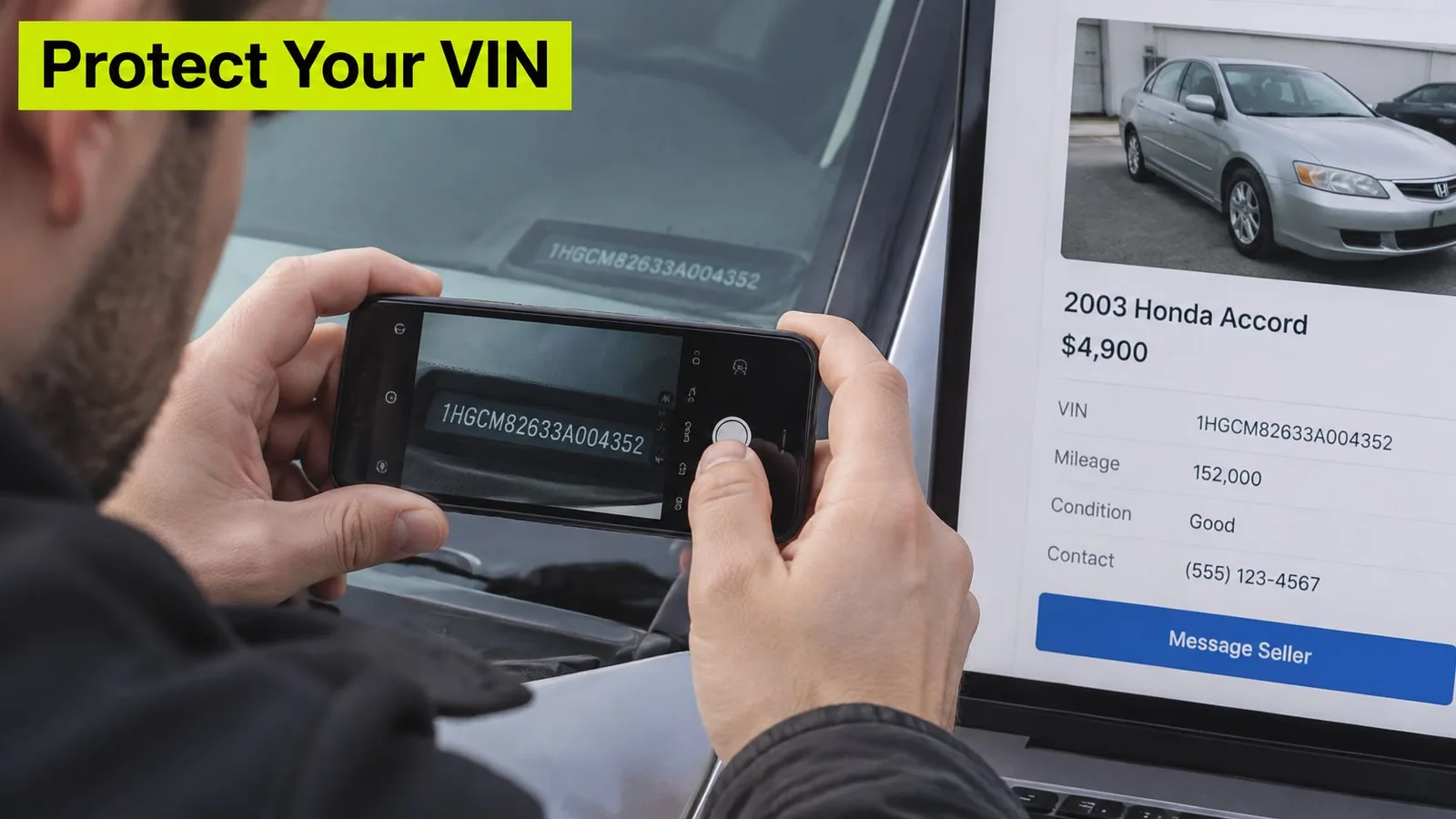
Research on connected-vehicle apps challenges that assumption directly. In Consumer Reports' coverage of the study, 28 of 30 connected-vehicle apps studied transmitted data to at least one external advertising or analytics company, and seven transmitted personally identifying information such as the owner's name, VIN or precise location. Security researchers describe the VIN as a persistent link across title records, insurance information and telematics, which can tie a vehicle identifier to a person's movements and to a home or workplace.
The VIN itself isn't automatically personal data in every legal context. It becomes personal when it's paired with something that identifies the owner.
Here's the video walkthrough of the same idea from the buyer's side.
The working rules are short. Share the VIN only when it's needed for a recall check, financing, insurance, or a legitimate history lookup. Don't pair it publicly with a name, street address, phone number, registration documents, or live location. Redact it on documents you send to strangers, such as a photo of a bill of sale, unless the buyer needs it to complete the transfer. If you're publishing listing photos, blurring license plates and similar identifiers handles the visible half of the same problem.
Practical rule: a VIN is safe to read and share for a purpose. It's risky to publish next to a name, a phone number or a location, and the combination is what does the damage, not the characters on their own.
Confirm the VIN Before You Buy or Sell
The sequence works like a funnel: free checks first, paid reports and an inspection once the VIN's identity checks out. You can run the first two steps in one sitting, and each one answers a question the others cannot.
1. Transcribe from two locations. Read the VIN at the base of the windshield and again on the door jamb, then compare all 17 characters. A single wrong character is usually a transcription slip; tags that tell two different stories are a reason to stop and look closer.
2. Decode it with the free NHTSA decoder. Check that make, model, year, engine and body match both the car in front of you and the paperwork. A misdescribed listing usually reveals itself here, such as an engine or trim the factory never installed in that model year.
3. Run the NHTSA recall lookup. The same 17 characters return any open safety recalls. Raise them with the seller before money changes hands, because an unrepaired recall becomes your repair bill after purchase.
4. Order a history report. Check title brands, theft flags and the latest reported odometer reading, and remember the report reflects what was reported. A clean record narrows the search; it never closes it.
5. Inspect the car physically. Panel gaps, paint mismatch, overspray and uneven tyre wear are the damage that never reached a database. A pre-purchase inspection by an independent mechanic is worth more than any report in this list.
6. Walk away when the story breaks. Leave if the decoded engine, plant or year disagrees with the car, if the title brand contradicts the seller's account, or if the seller refuses to show you the VIN in person.
CarShots keeps several of these checks free in one place, including a VIN decoder, a window sticker lookup, a bill of sale and a license plate blur tool, alongside a window sticker maker and a Buyers Guide. If you're preparing a car for sale rather than buying, our guide on how to sell a car covers the listing side, including the privacy steps above.
The takeaway: a VIN that decodes cleanly and matches the car confirms what the vehicle is. The paperwork, the records and a physical inspection tell you what it has been through.
Reading a VIN takes minutes and can save you from researching the wrong car, and CarShots gives you the free VIN decoder, window sticker lookup and bill of sale tools to do it. Decode the VIN, match the specification to the car in front of you, then use a history report and an inspection to answer the questions the identifier was never designed to answer. Start with the free tools at CarShots before your next listing or purchase.
- read a VIN number
- VIN number
- decode VIN
- VIN check digit
- vehicle identification number