

On this page
- Table of Contents
- Where an Original Window Sticker Usually Lives
- How to Find the Sticker on the Vehicle
- How to Request a Replacement Sticker or Build Sheet
- Telling Original, Reprinted and Reconstructed Stickers Apart
- How to Verify Every Detail Against the VIN
- What the Sticker Cannot Prove About Value
- Confirm the Sticker Before You Buy or Sell
If a seller sends you a crisp PDF stamped with your car's VIN, a full option list and a Monroney-style price block, what do you have? The natural answer is "the original window sticker." That PDF could just as easily be a manufacturer reprint or a third-party reconstruction, and the difference decides how much of it holds up when you negotiate, list or insure the car.
A genuine original vehicle window sticker is a physical, factory-issued label that sat on the glass before the first buyer saw the car. A manufacturer reprint reproduces that label later from the automaker's own records. A third-party reconstruction is built from decoded VIN data and inference. All three can look identical in a listing photo, and only one of them proves what the factory installed.
The reliable approach has three steps: find the strongest source that still exists, verify the document field by field against the vehicle, and label it in your own file so you know which of the three it is. Skipping the labeling step is how buyers end up quoting a reconstruction as if it were proof.
Table of Contents
- Where an Original Window Sticker Usually Lives
- How to Find the Sticker on the Vehicle
- How to Request a Replacement Sticker or Build Sheet
- Telling Original, Reprinted and Reconstructed Stickers Apart
- How to Verify Every Detail Against the VIN
- What the Sticker Cannot Prove About Value
- Confirm the Sticker Before You Buy or Sell
Where an Original Window Sticker Usually Lives
Find your row in the table and start with the source named in it. The strength of what you end up holding depends far more on where it came from than on how official it looks.
| Situation | Start with | Evidence strength | Notes |
|---|---|---|---|
| New car still on the dealer lot | Window sticker on the car or the dealer stock file | Original | Ask before the car leaves the lot |
| New car sold with the sticker removed | Dealer sales file or buyer's purchase packet | Original if located | Request a copy from the selling dealer |
| Used U.S. car, 1981 model year or later | Previous owner's or dealer's paperwork, then manufacturer build data | Original or reconstructed | Label the source that you actually used |
| Used car, pre-1981 | Archival manufacturer or dealer records | Only archival records confirm details | VIN decoding does not cover these years |
| Private sale with no paperwork | VIN-matched build-data request to the manufacturer or franchised dealer | Reconstructed unless an original record appears | Treat as unverified until proven |
| Imported or non-U.S. vehicle | Local pricing label or importer records | No U.S. label requirement | Market rules and label formats vary |
The reason this search is worth running at all goes back to federal law. The Automobile Information Disclosure Act required the label to be securely attached to the windshield or side window before the vehicle was delivered to a dealer, and it fixed what the label had to show: make and model, identification number, final assembly point, destination dealer, base suggested retail price, the suggested price of each installed option, transportation charges and the total suggested retail price.
That history answers the most common question about a used car with an empty windshield. The document existed on delivery day. The question is whether it survived and who kept a copy.
Three things decide the strength of what you turn up. A dealer stock file or a buyer's purchase packet hands you the factory document itself. A manufacturer build-data lookup gives you the configuration the factory recorded, reproduced in label form. A third-party lookup gives you a document assembled from decoded data and inference, which is useful for confirming equipment and useless as proof of original pricing.
Practical rule: Ask what the seller is handing you before you read a single number on it. The answer changes how much proof you actually have.
Write down your row and the first source to contact. That's your starting point, not your conclusion.
How to Find the Sticker on the Vehicle
When the car is in front of you, work through the glass first, because that's where the document spent its first weeks and where it leaves the clearest trace.
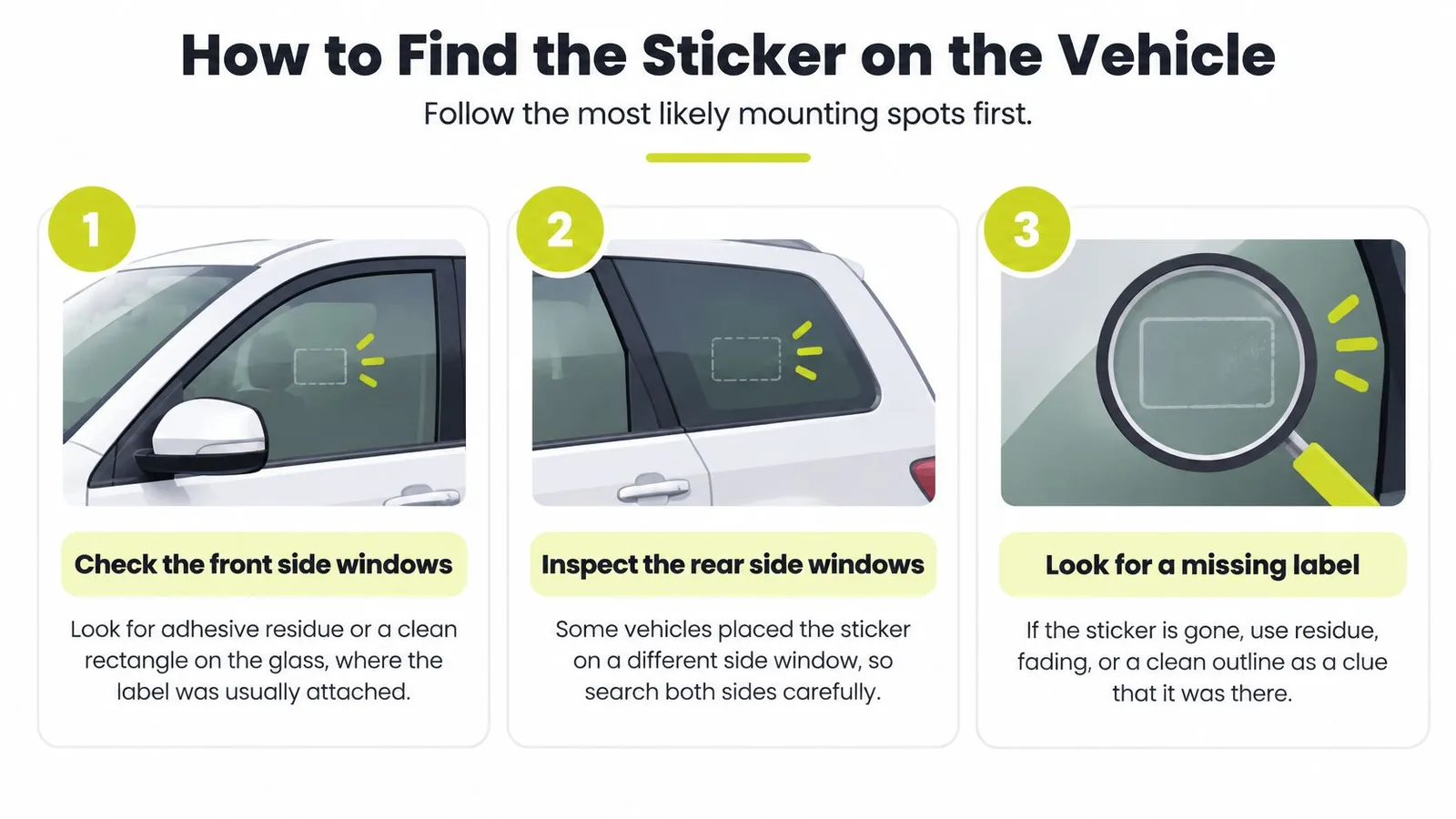
- Check the front side windows. The label was usually mounted there. Look for adhesive residue, a faint rectangle in the dust, or a noticeably clean patch on otherwise dirty glass. A removed sticker leaves a mark, and that mark tells you the document was taken off rather than never issued. The common slip is checking the driver's side and walking away.
- Search the rear side windows as well. Some vehicles had the label placed on a different pane, and replacement glass, tint work or a repaint can relocate it. The slip here is assuming a car with new glass never had a sticker at all.
- Open the owner's packet and the glove box. Labels get folded into the manual wallet, filed with the maintenance booklet, or tucked into the pouch with the purchase contract. The slip is flipping through the manual and missing a loose sheet wedged behind it.
- Search your email, the dealer portal and any online account. Dealers scan or photograph the label for the sales file, and that image frequently reaches the buyer as an attachment. Search the stock number as well as the word sticker, because file names rarely match what you'd type.
- Revisit the original listing. If the car came from a dealer's website, the archived listing may still carry the sticker photo or the factory price breakdown. Auction cars need a different ask: request the lot's stored sticker image or condition report from the auction house directly.
A copy pulled from a dealer's or an auction's own file outranks a photo somebody took later, even when the photo looks sharper. The file copy has a chain back to the transaction; the photo has a chain back to whoever held the phone.
If the selling dealer is the likely holder of the original, that request belongs with the formal records process rather than a phone call to the sales desk, and the next section sets out how to word it.
If none of these five steps produces a source, stop hunting and move to a build-data request. Guessing a car's factory options from what you can see is how option lists get inflated.
How to Request a Replacement Sticker or Build Sheet
Once you know the original is gone, the request becomes an evidence exercise. Run it like a claim file: freeze the facts, then work down a ranked list of sources.
Freeze the identity record on one page. That means the 17-character VIN, model year, make, model, trim, production date, selling market and current odometer reading. Every later request quotes from this page, and a single transposed character will send you to the wrong vehicle's record.
Work down the sources in order of strength
First the manufacturer's build-sheet or window-sticker service, because it draws on factory records. Then franchised dealer records, and ask the parts or service desk rather than sales, since those departments routinely pull build data by VIN for repairs. Then original delivery paperwork, then auction or ownership archives, and only last a third-party reproduction. The NHTSA vPIC decoder is a corroboration tool, not a sticker archive: it states that its decoder information is reported by manufacturers and that additional information may appear on labels affixed to the vehicle. Treat a decode as the sanity check on a sticker you already have, never as a replacement for it.
Ask for specific fields, not a summary
Request the base MSRP, the factory-installed options with their codes, the destination or freight charge, any regional equipment, and the date printed on the label. Option codes matter more than the marketing names in the brochure, because a package that reads as one line on a website can hide several separate factory items. Expect resistance on older vehicles: automakers restrict access to historic records, retire old databases, and sometimes return a partial configuration with no pricing at all. When that happens, you've learned something useful about the limit of the evidence.
Keep a file that survives scrutiny
Save the source document itself, the date you retrieved it, a file name built from the VIN, and an audit note marking every field as either sourced or inferred. Comparing a reconstructed label against contemporaneous manufacturer pricing for base MSRP, factory options, destination, regional equipment and the label date is what separates a defensible reconstruction from a plausible-looking one.
A sticker whose provenance can't be shown should be marked reconstructed in your own record, particularly on a pre-owned listing, a collector car or a cross-border import.
The pitfall that costs people the most is presenting a good reproduction as the original. The layout can be perfect while the option list, the market-specific charges or the original MSRP stay unverified.
Telling Original, Reprinted and Reconstructed Stickers Apart
A label that looks official is evidence of one thing only: that someone had access to a template. The term original window sticker gets used loosely, and in the U.S. the underlying document has a specific legal identity. The Monroney label is the factory-issued, federally required label on a new car, named for the senator who sponsored the disclosure law. Buyers outside the U.S. use "window sticker" for anything from a dealer price sheet to an importer's sheet, so the phrase alone tells you nothing.
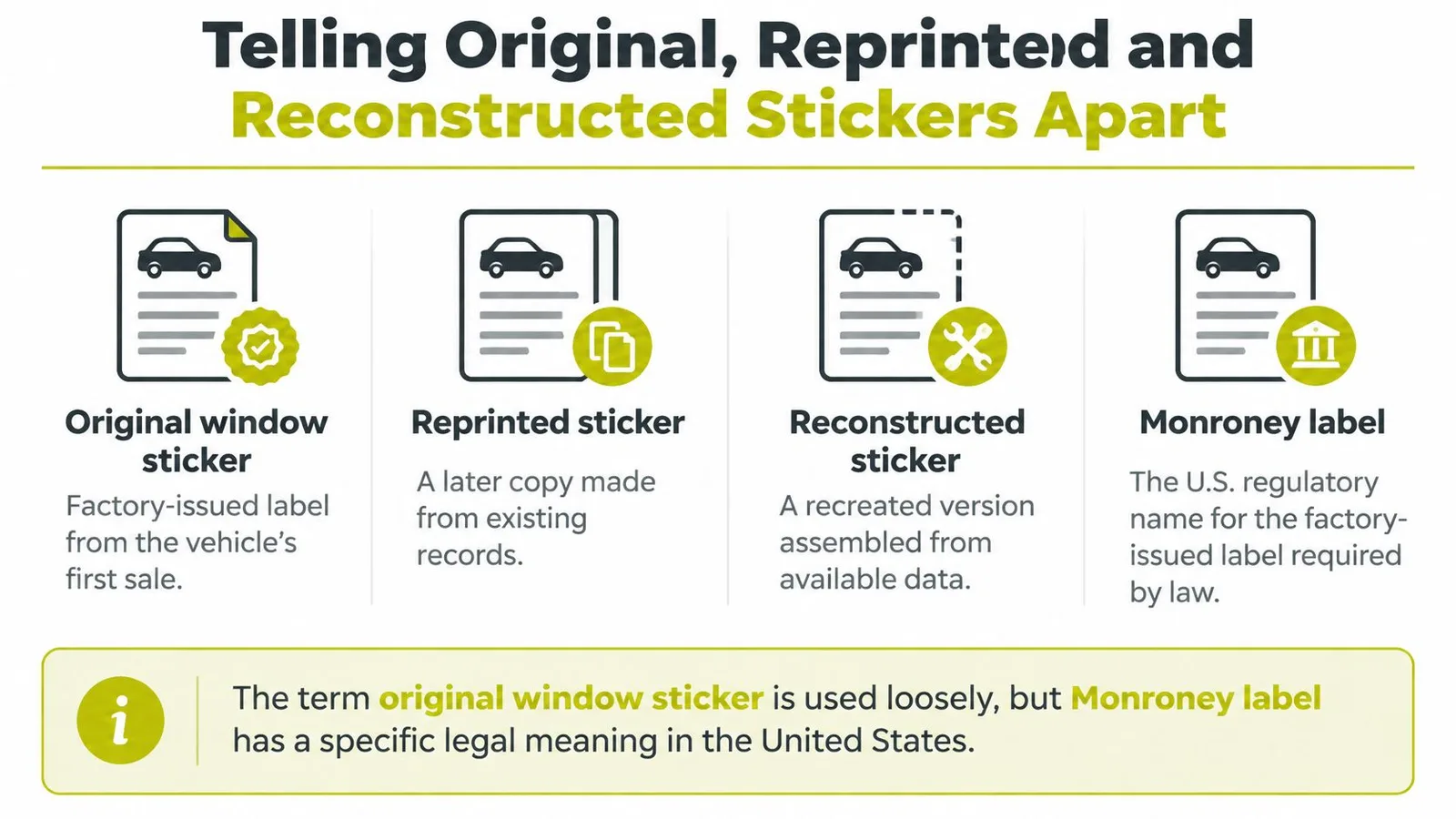
Three questions get blurred into one, and they need separate answers. Is this the original physical sticker issued at delivery? Is it a manufacturer-generated reprint of the factory label? Is it a third-party reconstruction built from build data? Ask them in that order and the answer tells you what the document can support.
The physical difference is easier to see than the digital one. A preserved original is the factory's own printed label, on factory paper, with the wear of a windshield behind it. A reprint reproduces the manufacturer's format from a later issue, often as a clean PDF, and it generally reflects real factory records. A reconstruction can mimic the brand's layout closely while its option list, market charges and original MSRP stay unverified, and some services draw exactly that line between a reconstructed report and an official manufacturer sticker.
That looks like in practice. Say a label arrives as a PDF matching a brand's format, with a destination charge and a full options block. The car in front of you has cloth seats; the label lists a leather package. The destination figure doesn't match the delivery market you were told the car sold in. Either detail alone is enough to stop treating the document as a factory record, and together they point to a reconstruction with a copied template.
Dealer-installed accessories belong in a separate column entirely. Paint protection, tint, nitrogen fills and etching are not factory options and never appeared on the original label, so a document that folds them into the factory option list has mixed two different things.
Write one of the three labels, original, reprint or reconstruction, on every document you rely on, and note who supplied it. Availability varies by brand and model year, since automakers can restrict access, delete older records or release only partial detail, so a gap in the record is normal rather than suspicious. What isn't normal is a document with no stated origin.
How to Verify Every Detail Against the VIN
A single wrong character voids every check that follows, so verify the VIN before anything else. Capture all 17 characters from the certification label, the dashboard, the title or the manufacturer record, then compare them to the sticker one at a time. Reading the sequence aloud in pairs catches the transpositions that eyeballing misses.
What each VIN position proves
For vehicles from the 1981 model year onward, NHTSA's VIN guidance sets out the structure: positions 1 through 3 identify the manufacturer, positions 4 through 8 describe vehicle attributes such as body style, engine and restraint system, position 9 is the check digit, position 10 is the model year, position 11 is the assembly plant, and positions 12 through 17 are the sequential production number. Validate the check digit first, then decode the rest.
That decoding gives you the acceptance test worth applying to any document. The VIN on the sticker equals the VIN on the car, the decoded make, model, body, engine, model year and plant are plausible for that vehicle, and the equipment list, MSRP, destination charge and option codes reconcile with the manufacturer's configuration. Miss any of the three and you have an inconsistency to resolve before money moves.
| Field | What to check | Red flag |
|---|---|---|
| VIN | Matches the windshield, door jamb, dashboard, title and listing | Any transposed or missing character |
| Model year | Matches the title and decoded position 10 | A label that shows the build date as the model year |
| Assembly plant | Decoded plant is plausible for this model | Plant does not match the build country |
| Body, engine and trim | Matches the car in front of you | Engine or body that differs from the decoded record |
| Base MSRP | Matches the manufacturer's configuration for that year | Price that does not align with the trim |
| Factory options and codes | Each code appears in the build data and on the car | Options listed that the car does not have |
| Destination charge | Matches the regional schedule for the delivery market | A freight figure that appears twice or doesn't fit the market |
| Pre-1981 vehicles | VIN decoding is not available | Relying on decoding alone for any detail |
The failures that repeat
Transposed characters are the most common error and the most damaging, because every downstream check inherits it. Model year confused with build date comes next: a car assembled in late 2020 can carry a 2021 model year, and a label that prints the build date as the model year is wrong on its face. Treating a reprint or reconstruction as an original inflates what the document proves, since only a factory-issued label confirms what the car carried when it shipped. Assuming decoded data proves factory options is the quiet failure, because a decoder tells you what the VIN was built to be, not every accessory installed at the plant or port.
Pre-1981 vehicles sit outside this system entirely, and archival manufacturer or dealer records are the only route there. For a position-by-position walkthrough of the sequence, the guide to how to read a VIN number goes through each character in order.
What the Sticker Cannot Prove About Value
Four numbers get quoted in the same conversation as if they were one, and mixing them is how a $25,575 car becomes a $27,265 negotiation anchor that nobody can defend.
| Number | What it means | Example | Verified by |
|---|---|---|---|
| Original MSRP | Price new for the configured trim and options, before destination | $25,575 | The original sticker |
| Sticker price with destination | Delivered total printed on the original label | $27,265 | The original sticker |
| Current advertised price | Today's listing or asking price | The ask shown on the current listing | The seller or dealer, dated when listed |
| Estimated market value | Worth today, adjusted for model year, condition and market | What recent comparable cars actually sold for | Not on the sticker |
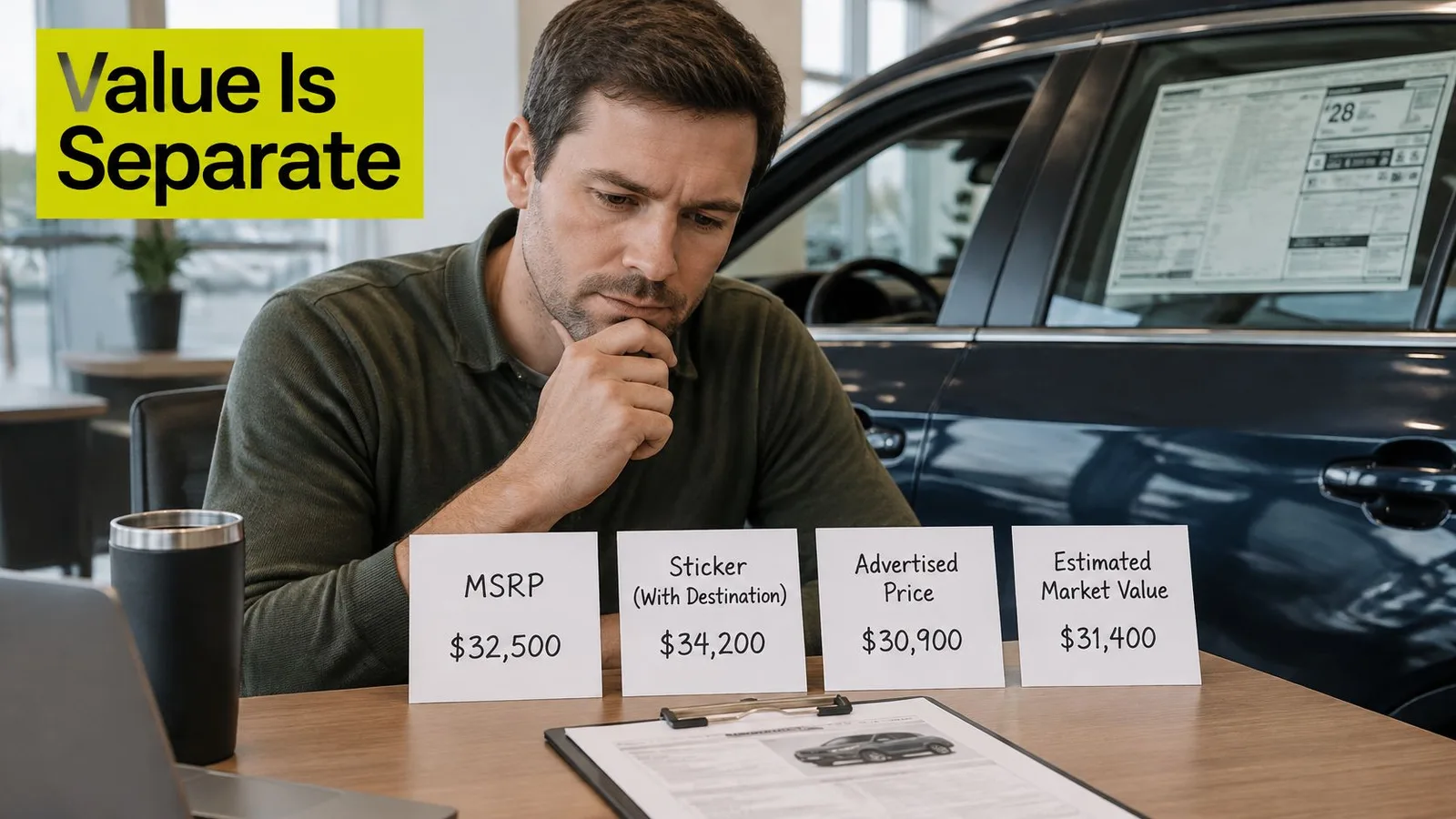
A published sample of an original factory sticker for a 2025 Hyundai Elantra SEL Convenience, shown in the GlobalVIN window sticker API documentation, listed an MSRP of $25,575 and a delivered total of $27,265. That $1,690 gap is the destination and delivery charge printed on the label. It is not a discount, and it is not negotiable.
The label proves configuration and original cost. Depreciation, the dealer's asking price, financing, taxes and the condition of a used car all sit outside what the document can show. Factory options raise original MSRP without lifting resale value in proportion, and later modifications make two cars harder to compare at all.
Dealers run into this when they price against the sticker instead of the market. A car that left the factory at $30,000 can still sit if comparable cars in the area sell for less, which is why a priced-right check against current market listings settles the question faster than quoting the original label. Buyers do the same math in reverse: a seller who anchors on MSRP is telling you how much the car cost, not what it is worth today.
Electrified vehicles give the label one more job. Federal clean-vehicle-credit eligibility has used MSRP caps of $80,000 for vans, SUVs and pickups and $55,000 for other vehicles, with MSRP calculated from the particular vehicle's trim, options and accessories while excluding destination charges and dealer-provided options, as the Alternative Fuels Data Center sets out. A sticker can show whether a car sits under a cap. It cannot prove eligibility, because tax rules, battery requirements, purchaser qualifications and the placed-in-service date all bear on that too.
Put the original sticker beside today's price only if every figure is labeled by date and purpose. An old MSRP presented as a discount benchmark misleads the buyer and invites the argument you were trying to avoid.
Confirm the Sticker Before You Buy or Sell
I need to revise the "Confirm the Sticker Before You Buy or Sell" section. The claim about pulling manufacturer's records via the VIN decoder link is unsupported. I'll keep the CTA but rephrase it to invite users to use the free VIN decoder and window sticker lookup tools, linking to carshots.ai without overstating their capabilities. I must also preserve the H2 heading, the numbered checklist, the blockquote, the mandatory internal link, and factual product mentions, while avoiding repetition with the previous section.
I need to ensure the rewritten text avoids invented facts, relying solely on provided section and business facts. I can use specific knowledge base articles (K1, K3, K4, K6, K8, K10, K20) and must include the mandatory link https://carshots.ai/blog/buyers-guide-form exactly once with a descriptive anchor. The existing internal link to carshots.ai for free tools should be preserved once, rephrased to "try the free VIN decoder and window sticker lookup" without claiming manufacturer's records. No external links from previous sections should be included, and all backlinks must be removed. The final output should have an approximate word count of 160-210 words, with varied rhythm and no em dashes or banned phrases.
I need to refine the wording for the sticker categories. Instead of just "original physical label, manufacturer reprint, or reconstruction," I should ask buyers which of these three types they have. This clarifies the provenance question and supports the subsequent steps in the process. The product mention about CarShots labels seems solid, as does the blockquote's core message.
The draft CTA claims CarShots keeps specific data on one page per car. It also suggests using free VIN decoder and window sticker lookup tools to start checks, then confirming against the physical label to avoid manufacturer's records. I need to verify if the claim "tools to start VIN and equipment check" is supported, as free tools exist and overclaiming should be avoided. The phrasing should be adjusted to state "free tools."
- original window sticker
- Monroney sticker
- VIN check
- build sheet
- window sticker lookup