

On this page
- Table of Contents
- What the Buyers Guide Form Is
- Buyers Guide Form Sections at a Glance
- Warranty Choices on the Buyers Guide Form
- Paper Size Ink and Wording Rules
- Spanish Sales and States That Limit As Is
- How to Complete and Post Each Guide
- Reading the Guide as a Shopper
- Records the Buyers Guide Does Not Replace
- Keeping the Guide, Listing and Lot in Sync
- What the 2018 Lot Inspections Found
In 2024, 80% of car buyers said they wanted to complete more of the purchasing process from home, up from 69% in 2023, according to the CarGurus Consumer Insight Report. That shift changes how a buyers guide form has to work. A shopper may read the warranty story on a phone the night before, then stand at the car and read a different story on the glass.
The form is not a brochure. It is a dated, VIN-linked record of what the dealer will and will not pay to fix. The window copy, the advertised price with fees, the recall note, the photos, and the page the shopper saw before the visit all have to say the same thing. If they don't, the shopper is not confused by fine print. The store published two deals.
A digital copy can contradict the window copy in a single afternoon. Someone changes the warranty on the desk, reprints nothing, and the car is still shown. The check that matters is the one you run the same day, before any shopper is handed the keys.
Table of Contents
- What the Buyers Guide Form Is
- Buyers Guide Form Sections at a Glance
- Warranty Choices on the Buyers Guide Form
- Paper Size Ink and Wording Rules
- Spanish Sales and States That Limit As Is
- How to Complete and Post Each Guide
- Reading the Guide as a Shopper
- Records the Buyers Guide Does Not Replace
- Keeping the Guide, Listing and Lot in Sync
- What the 2018 Lot Inspections Found
What the Buyers Guide Form Is
Most dealers who sell more than five used vehicles in a 12-month period must put a Buyers Guide on every used vehicle they offer, including cars sold on consignment. The FTC's answers on the revised Used Car Rule trace that duty to the Used Motor Vehicle Trade Regulation Rule, in force since 1985. Timing is strict. The Guide has to be on the vehicle before it is displayed for sale or made available for a shopper to inspect.
The form records one of two outcomes. The car is sold "as is," or the dealer offers a warranty. When a dealer warranty applies, three details follow: the systems covered, the duration, and the percentage of repair costs the dealer will pay. Those three lines are the promise. A blank percentage is not a partial warranty. It is an unfinished form.
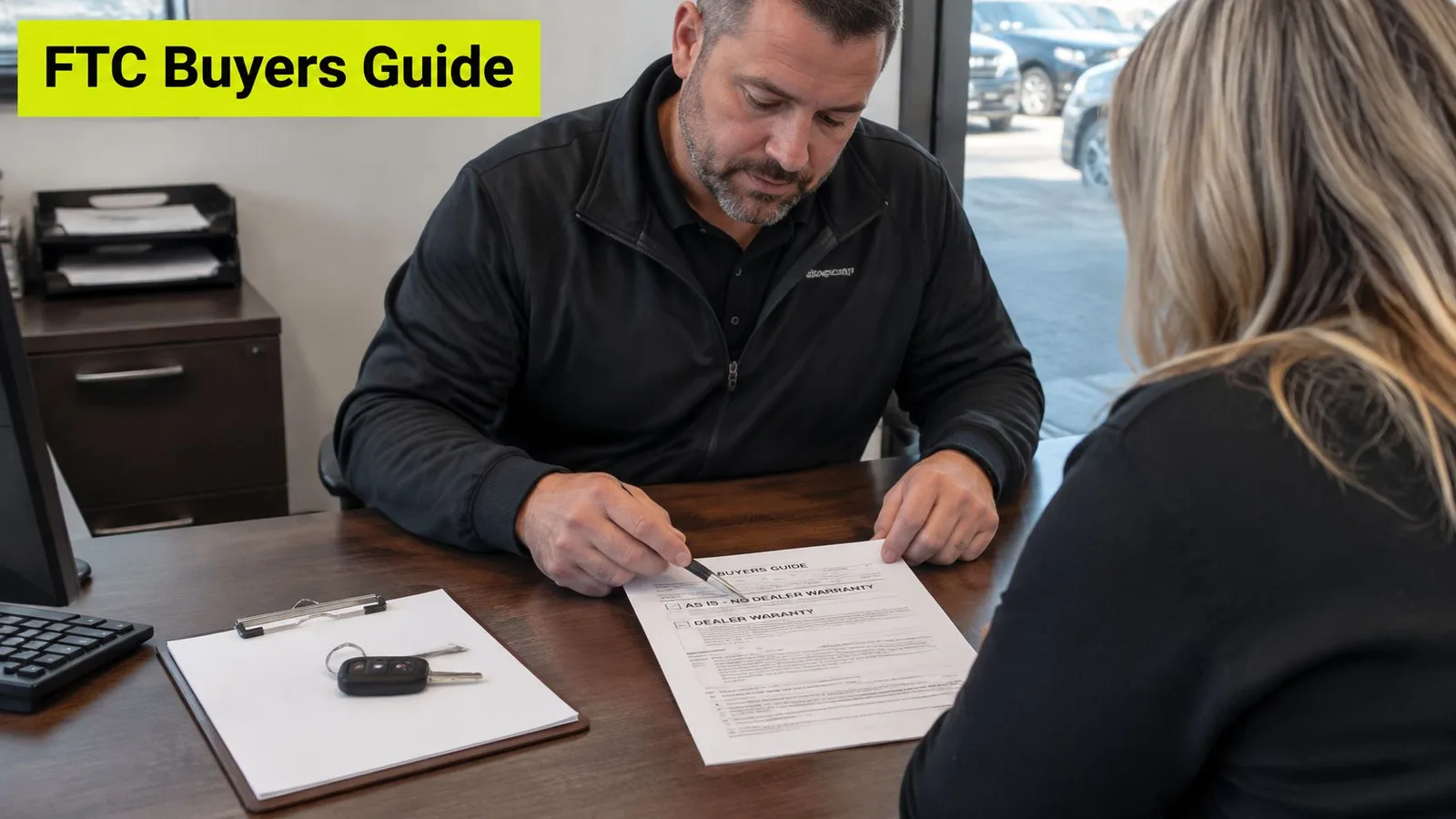
After the sale, the buyer gets a completed copy. Keep one with the deal. If the Guide and the sales contract disagree, the Buyers Guide controls. A contract clause that reduces coverage does not win that fight. Staff who "fix it in the contract" after the window form is posted are writing the wrong document.
Some states restrict "as is" sales. In those states you use an alternative Buyers Guide that reflects the warranty the state requires. That exception is a different sheet, not a footnote you add to the federal as-is face. The next section is the field lookup you can keep beside you while you fill a form.
Buyers Guide Form Sections at a Glance
Read the buyers guide form from top to bottom, the same way a shopper will. Each block is either on every Guide or only when that coverage exists. Don't fill a block "just in case," and don't skip a block because the car "usually" has that coverage.
Start with identity, then who stands behind the form, then the warranty election, then the side marks, then the notices that don't change from car to car. The buyer copy is the last step, not a box you check while the car is still on the line.
| Section | What it must contain | When it applies |
|---|---|---|
| Vehicle identity | Make, model, model year, and VIN | Every used vehicle offered for sale |
| Dealer identification | Dealer name, address, and a contact for complaints | Every Guide |
| As is, no dealer warranty | The as-is box and the standard disclaimer | When the dealer offers no warranty and state law allows as-is sales |
| Dealer warranty | Full or limited, systems covered, duration, and percent of repair costs the dealer pays | When the dealer itself warrants the vehicle |
| Unexpired manufacturer warranty | A marked box that coverage from the manufacturer may still apply | When that warranty has not expired; not written as the dealer warranty |
| Third-party warranty | An indicator that a non-dealer warranty may apply | When such coverage exists; terms stay off the dealer-warranty block |
| Service contract | A statement that a service contract is available | When the dealer offers one; it is not the warranty |
| Major defects | The standard systems list, including air bags and catalytic converters on the revised Guide | Every revised Guide |
| History report and recalls | Direction to obtain a vehicle-history report and check open recalls | Every revised Guide |
| Spoken promises | Standard warning to get promises in writing | Every Guide |
| Spanish notice | Spanish disclosures or the Spanish Buyers Guide | When the sale is conducted in Spanish |
| Buyer copy | The completed Guide given to the buyer and kept with the deal | After the sale |
How to use the rows
Identity first. Make, model, year, and VIN tie this sheet to one car. A Guide from yesterday's trade, left in the window, fails this row even if every warranty box looks neat.
Dealer block next. Name, address, and a complaint contact go on every Guide. A shopper who has a problem needs a person, not a slogan.
One warranty election. As is and a dealer warranty are mutually exclusive. You don't check both. Systems, duration, and the dealer's percent appear only when the dealer is the one warranting the car.
Side indicators are not the warranty. An unexpired manufacturer warranty, a third-party warranty, and an available service contract each get their own mark, and only when that product is real for this VIN. They don't fill the dealer-warranty block and they don't uncheck as is.
Notices that ride on every revised Guide. The major-defect list, including air bags and catalytic converters, plus the direction to get a vehicle-history report and check open recalls, is standard text. So is the warning that spoken promises are hard to enforce and belong in the contract. The Spanish face is different: it applies when the deal is conducted in Spanish, not because the inventory system defaults to bilingual.
Use this table while you fill. Then choose the warranty box with the rules in the next section, not from memory of the last car you posted.
Warranty Choices on the Buyers Guide Form
The warranty decision is one choice, plus side disclosures. It is not a stack of warranties written into one block. The FTC's automobile guidance requires the form before a used vehicle is offered or inspected, including consignment cars, and it requires make, model, year, VIN, the as-is or warranty statement, and, when the dealer warrants the car, systems, duration, and the dealer's share of repair costs. Dealer name and a complaint contact sit on that same sheet. Standardized wording, type style, type size, and format can't be altered.
As is means the dealer-warranty box stays blank. The buyer pays for repairs after the sale, and only where state law allows that sale. Full and limited are the dealer's own promises. Name the systems, the time or mileage, and the percentage, such as 50 percent or 100 percent of listed parts and labor. Leave none of those three blank.
An unexpired manufacturer's warranty is marked in its own box. You don't restate it as if the dealer will pay. A third-party warranty, including a warranty-company contract, gets an indicator only. A service contract is optional coverage the buyer can purchase. It doesn't uncheck as is, and it doesn't become the dealer's percentage.
One car, three marks
Say a six-year-old sedan is sold as is, where that sale is legal. A service contract is available at the desk. An OEM powertrain warranty still has miles left. The Guide shows three different marks: the as-is box, the service-contract note, and the manufacturer-warranty box. The dealer systems list stays empty. Nobody copies "powertrain" into the dealer block and calls that a warranty.
| Choice | Who pays for repairs | What the Guide must show | Usual error |
|---|---|---|---|
| As is, no dealer warranty | The buyer, for repairs after sale | As-is box only, where state law allows it | Checking as is in a state that restricts those sales |
| Full dealer warranty | The dealer, at the stated percentage, for covered systems | Full box, systems, duration, and percent | Omitting duration or the dealer's share |
| Limited dealer warranty | The dealer, only for listed systems and the stated share | Limited box, named systems, duration, and percent | Leaving the systems list or percent blank |
| Unexpired manufacturer warranty | The manufacturer under its own terms | Its own box, not the dealer-warranty block | Copying OEM coverage into the dealer warranty |
| Third-party warranty | The warranty company, not the dealer | An indicator only | Adding the company's logo or extra wording |
| Service contract | The contract the buyer purchases sets the payer | A note that a contract is available | Treating the contract as the dealer warranty |
Practical rule: If you can't name who pays, which parts, for how long, and what share, you don't have a dealer warranty yet. You have a blank.
Three mistakes show up on almost every messy lot. Staff check as is where that sale is banned. They leave the percent line empty on a "limited" warranty. Or they paste a warranty-company logo onto the standardized face. The logo is not a disclosure. It is an alteration.
A digital workflow should treat VIN, warranty status, systems, duration, repair-cost percentage, dealer contact, and the state rule as required fields, with validation and a revision history a manager can audit. A car page can show the same choices. It doesn't replace the physical Guide where display is required, and the physical sheet is 100% black ink on white paper at least 11 by 7.25 inches.
Paper Size Ink and Wording Rules
The sheet a regulator will recognize is plain on purpose. Print it in 100 percent black ink on white paper at least 11 by 7.25 inches. The FTC Dealers Guide to the Used Car Rule lets you generate the form on a computer. It does not let you restyle it. Prescribed wording, type style, type sizes, and format stay intact.
What you may not add
Don't put any of these on the standardized face:
- Dealer logo or slogan. Branding belongs on the spec sheet, not inside the Guide.
- A symbol or QR code. A code that jumps to financing is extra content.
- A sales sentence. "Best price in town" is not part of the required text.
- A warranty-company mark. Third-party coverage is an indicator, not a redesign.
Third-party warranties, such as manufacturer or warranty-company obligations, don't have to be disclosed as dealer warranties. The dealer's own terms do. Keep warranty provider, warranty type, systems, duration, the customer's share, and exclusions as separate data. A person approves the sheet before it is posted. A template that merges a logo "for a cleaner look" is the failure mode, not a design upgrade.
The one size exception
If the systems list or the duration language needs more room, use a larger sheet. Don't shrink the type. Don't delete a block to make the federal minimum fit. The required sentences stay word for word. What may change from car to car is the data: VIN, stock identity, warranty selection, systems, duration, and percentage. What may not change is the surrounding language.
Before the car is lined out, set your print beside the FTC English form. Same headings. Same boxes. No marketing frame. A window sticker, a website description, and a history-report link can sit beside the Guide. They are not printed into its mandatory text. When warranty terms or identity data change, the old sheet comes off and a new one is generated, timestamped, and tied to that VIN and stock record. Generation happens before the listing is public, and the finished Guide stays with the deal jacket.
Spanish Sales and States That Limit As Is
Two situations force a different sheet than the default English as-is Guide. They are separate problems, and a laminated "one form for the lot" fails both. They can also stack on the same car, which is where stores get surprised.
When the conversation is in Spanish
If the sale is conducted in Spanish, use the Spanish Buyers Guide or provide the required Spanish disclosures. An English-only window form doesn't cover that transaction. Staff who negotiate in Spanish post the Spanish version before inspection, not at signing as a courtesy packet.
The shopper who test-drives at 10 a.m. is already inspecting the car. Handing over the right language at 4 p.m. is late. The Spanish sheet is its own record: same VIN, same stock identity, its own warranty selection, generated for that vehicle rather than translated on the fly at the desk.
When the state limits as is
Some states restrict or ban as-is sales of used vehicles. In those states you can't check the federal as-is box and hope a contract disclaimer repairs it. The alternative Guide reflects the warranty the state requires, including which systems are covered and for how long. When the dealer is the warrantor, the dealer's percentage still has to be filled. A multi-state group should not keep a single laminated Guide for the whole inventory. The car is offered in a place, and that place sets the face.
Confirm the rule in the state where this car is offered, using that state's motor vehicle dealer regulations, the FTC's Used Car Rule guidance, or a state-by-state reference on where as-is sales are limited. Do it before you print, not after a shopper has already walked the lot.
A four-step choice
- Name the state where this vehicle is offered for sale, not the state on the title from three owners ago.
- Confirm whether as is is permitted there. If it isn't, the alternative Guide is the only legal face.
- Match the language of the deal. English negotiation, English face. Spanish negotiation, Spanish face, on the glass before the car is shown.
- Complete the warranty fields that face asks for, including the dealer's percent when the dealer is warranting the car.
If the language of the conversation and the language on the glass don't match, you don't have a disclosure yet. You have a form the shopper can't use.
A same-day check takes under a minute per car. Before any vehicle is shown, confirm the Guide on the glass carries this VIN, the sale type this state allows, and the language used in the conversation. Any mismatch means the record gets corrected before the door opens.
How to Complete and Post Each Guide
Lot order matters more than a perfect PDF in a folder nobody prints. Run these eight steps on every used car, including a consignment unit that "isn't really ours yet."
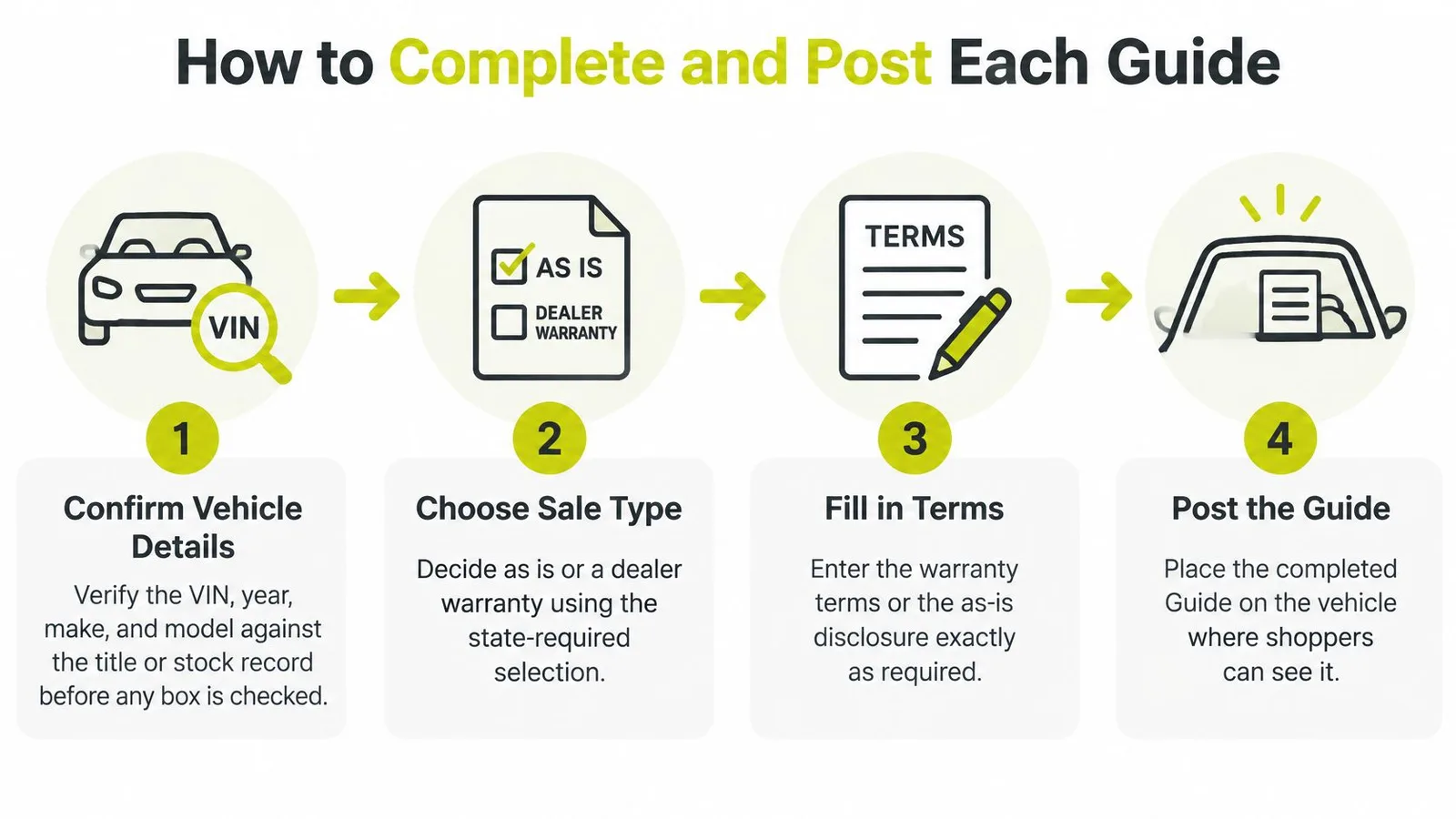
- Confirm the car. Match VIN, year, make, and model to the title or stock record before any box is checked. A transposed digit ties the promise to the wrong vehicle.
- Pick the sale type from the state rule. As is only where it is allowed. If the dealer warrants the car, enter systems, duration, and the dealer's percent in the same sitting. Don't leave percent for "finance to finish."
- Mark side products only if they exist. Manufacturer, third-party, and service-contract indicators go on when those products apply to this VIN. A menu the store sometimes sells is not a mark.
- Second set of eyes. Another person compares the sheet with the stock card. A price change or a warranty change from yesterday can't ride out on yesterday's form.
- Print and post before inspection. Black on white, at the required size, in the vehicle before any shopper can look it over. The failure here is posting after the first test drive. By then the car has already been offered.
- Reprint on change. If warranty terms or identity data change, pull the old Guide, print a new one, and note the time. A crossed-out guess in the margin is not a controlled revision.
- At the sale, two copies. The buyer gets the completed Guide. One stays in the deal jacket. The failure here is closing on a contract that disagrees with the window sheet and hoping the contract wins.
- If they conflict, fix the contract. The Guide is the controlling disclosure. Rewrite the contract to match it. Don't edit the Guide down to a looser promise after the shopper has relied on the window.
Two cars that expose a bad routine
A traded sedan still wearing the previous stock number's Guide will show the wrong VIN the moment anyone compares glass to title. A car that goes on a test drive with the Guide "coming from the printer" has already been made available for inspection. Both are the same process break: the sheet is treated as paperwork for the folder, not as the sign on the car.
Reading the Guide as a Shopper
Before you visit, leave a deposit, or sign, read the two outcomes on the glass. A box marked as is means you pay for repairs after the sale, where state law allows that sale. A dealer warranty means the dealer pays the stated percentage of repair costs for the listed systems, for the stated time or mileage.
Walk the buyers guide form in this order:
- Match the car. Make, model, year, and VIN should be the car in your hand, not a sister unit.
- Read the warranty box. If a dealer warranty applies, write down systems, duration, and the percent the dealer pays.
- Separate the other marks. An unexpired manufacturer warranty, a third-party warranty, and an available service contract are each their own coverage.
- Scan the major-defect list, including air bags and catalytic converters, so you know which systems the form is talking about.
- Get a vehicle-history report and check open recalls before you sign. The notice on the form is a direction, not the report itself.
- Match the language. Spanish deal, Spanish face. English deal, English face.
- Put every promise in writing. Spoken promises are hard to enforce.
If the contract conflicts with the Guide, ask the dealer to correct the contract before you sign. The Guide controls that conflict.
No Guide on the car? Ask for the completed form for that VIN, the warranty election in writing, the history report, and the open-recall check before you inspect further or leave money.
Records the Buyers Guide Does Not Replace
The Guide is a dated, VIN-linked election. Papers near it can look official while doing a different job.
A window sticker on a new vehicle, or a dealer spec sheet on a used one, lists equipment and price detail. It belongs beside the price, but it does not mark as is or name a dealer warranty.
A bill of sale or retail contract records the bargain at signing. If its warranty words conflict with the Guide, the Guide controls, so the contract should be written to match before signature. Signing first and cleaning up the window later reverses that order. Record-retention periods are a separate question to confirm with the applicable state and federal rules; for the filing side, use dealer record retention while counsel confirms the periods that govern the store.
A vehicle-history report and an open-recall check are what the Guide tells you to obtain. The form points to them. It is not the report, and the links belong beside the listing.
A service contract has its own terms and cancellation rules, outside the dealer repair-cost percentage. Buying one does not turn an as-is car into a dealer-warranted car.
Before any car is shown, same day, match the VIN and version date on the Guide to the listing price, fees, and lot copy. If a box differs, pull that unit until the record agrees.
Keeping the Guide, Listing and Lot in Sync
Digitizing the form can make a mismatch easier to publish, not harder, and a shopper can compare five screens before anyone walks them to a car. A Buyers Guide works like a dated title entry. It belongs to one VIN, on one day, carrying one set of warranty choices. When the page, the price and the window sheet show different versions of that record, the shopper reads it as two different deals.
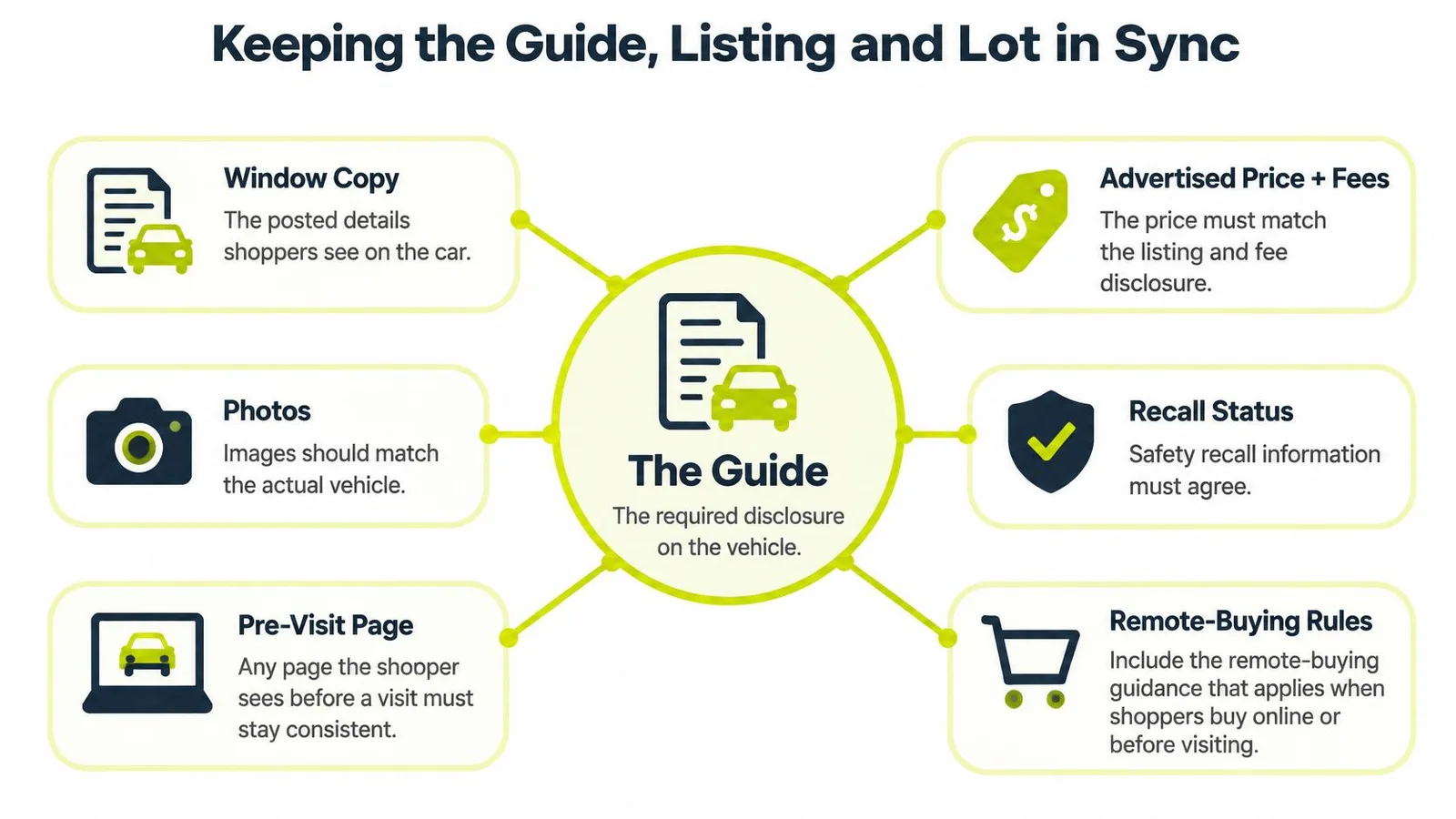
Where it sits on a vehicle page. Beside the price and the warranty statement, labeled with the VIN and a version date, showing the same boxes as the window form. Car Pages for used cars include the FTC Buyers Guide, and each page shows the dealer's price with its fees plus the Guide in English and Spanish. The rules for what belongs inside that figure, and what must be disclosed beside it, are covered in our guide to FTC pricing rules for car dealers.
Whether a shopper can see it before a visit or a deposit. Yes, as a preview. The preview does not replace the physical Guide where display is required, and it expires the moment the car's facts do. Regenerate it when condition, warranty language, or identity data changes. A PDF saved on Monday is not Tuesday's car.
What fails when only the PDF is digitized. An as-is Guide can sit beside a listing that implies dealer coverage, or beside a price that omits fees the desk will add later. Photos of a different unit and a stale recall line do the same damage, because the shopper cannot tell which copy belongs to the car in front of them. Each copy is a snapshot of the car at a moment in time, and only one of them should be current.
Same-day check before the car is shown
Run it like a preflight list. Seven items, all quick, all checked against the car itself.
- VIN matches the stock record and the title.
- The as-is or dealer-warranty box matches the listing.
- Dealer percent and systems are filled if a warranty applies.
- Price with fees matches the page.
- Recall note and photos match this car.
- Spanish or English face matches the conversation.
- Print time is later than the last warranty change, and the sheet is in the car before the appointment.
If any item is blank or stale, the car is not ready to show. We keep a free Buyers Guide among the desk tools, next to a VIN decoder and a window-sticker lookup, so the sheet can be rebuilt from the stock record instead of retyped from memory.
What the 2018 Lot Inspections Found
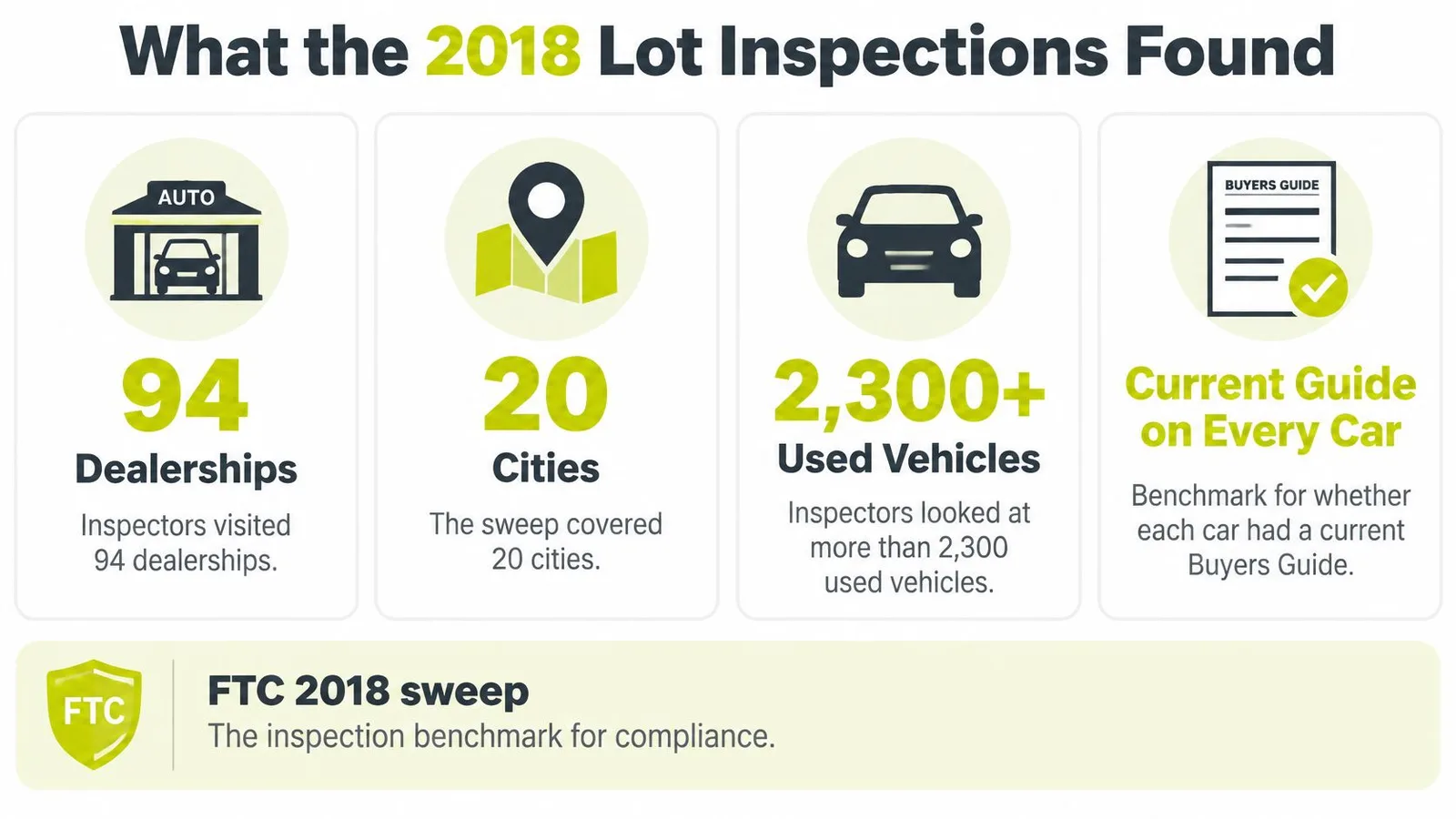
A process is real only if a current Guide is on every car a shopper can touch. The FTC's 2018 look at revised Buyers Guides is the benchmark. Inspectors visited 94 dealerships in 20 cities and examined more than 2,300 used vehicles. Guides were present on approximately 70% of the vehicles, so roughly 30% had no required disclosure at inspection.
The revised form had been mandatory since January 28, 2018, after a November 18, 2016 amendment. Almost half of inspected vehicles showed that revised Guide. Among the 94 stores, only 14 had the revised Guide on every used vehicle inspected, and 33 had it on more than half. An old laminated sheet fails for a reason. The revision added third-party and service-contract indicators, a manufacturer-warranty box, air bags and catalytic converters, history-report and recall guidance, and Spanish notices.
A four-count audit you can run this week
Don't wait for an inspector to do the arithmetic.
- Count the line. Every used vehicle offered, including consignment and anything a shopper can inspect.
- Count Guides present. A car with no sheet is a miss, even if the folder has a PDF.
- Count revised Guides. Pre-revision laminates don't carry the added marks and notices.
- Count VIN matches. The number on the glass has to be the number on that car.
A 30% gap on a 40-car lot is about 12 cars a shopper could inspect with no disclosure. That is the same rate the 2018 sweep found, applied to a small independent line. If your four counts don't match, those cars stay off appointment until the sheet, the VIN, and the revised face agree.
Twelve cars with no Guide is not a paperwork backlog. It is twelve inspections you already allowed.
Run the four counts before the first appointment of the day. The form that isn't on the car isn't a disclosure, no matter how complete it looks in a shared drive.
CarShots includes a free Buyers Guide you can fill from the VIN, in English or Spanish, and place on a Car Page next to the price with fees. Use it with the same-day check so the window copy and the page a shopper saw from home stay one record. Visit CarShots and build the sheet before the car is shown.
- buyers guide form
- FTC used car rule
- as is warranty
- dealership compliance
- used car disclosure